Bad Games Deserve to Fail | Part 2 of A Response to Comicbook.com's Idiotic Article
Welcome back to my response to Comicbook.com’s article, “The Video Game Industry Has a Major Problem (& It’s Gamers’ Fault),” written by Justin Joy. If you haven’t read the article or do not wish to, the quick summary is that Mr. Joy believes that some “good” games made by large (AAA) companies are failing financially because gamers are too negative and not enough is being done to stop the negativity from spreading within the online community.
In Part 1 of my response, I tackled the author’s opening observations about the status of the video game industry and the atmosphere of negativity he sees in it. I also expanded upon my opinions of how his views range from naive to plain wrong, with my own examples of how negative criticism from customers is sometimes warranted or even helpful in the long-run of a game’s life cycle. In Part 2 of my response, I’ll be focusing on the games the Comicbook.com writer chose as examples for his argument and why I think his argument is just wrong.
Again, I’ve included the text from their article in the accordion for the sake of backing up the content and convenience, but you can click this link to go directly to the article to see for yourself. In Part 2 of my response, I will be including quotes and responding to each paragraph as we go along, starting with the section titled “Sometimes Good Games Get Set Up for Failure”.
-
There is a growing problem in modern gaming culture that is impossible to ignore. I see it every time I watch a PlayStation showcase, a Nintendo Direct, or any other gaming-related stream. The gaming industry is bigger, and expectations are higher. And with the internet being more readily available than ever, there is a bigger scrutiny on upcoming and newly released games. Together, these have led to an increase in the negative ways gamers interact with developers.
The atmosphere in the gaming industry has shifted from questioning to outright hostility. I’m used to skepticism or cautious optimism, but now, players take every opportunity to trash a game, even if they’ve only seen a few minutes of gameplay through a reveal trailer. Gamers are calling a game doomed before it even launches, which negatively impacts its sales, sometimes even causing it to fail entirely. This isn’t to say every game fails because of bad press and negative word of mouth, but to completely write a game off without trying it has seemingly become the norm for a majority of people who supposedly love video games.
Gamers Are More Excited for a Game to Fail Than Succeed
At some point, cheering for a game’s downfall became entertainment. Whether the cause is influencer culture, social media hot takes, or the algorithm’s hunger for negativity, the outcome is the same. The loudest voices online often seem to revel in failure. You can see this during any major livestream. It happened during the PlayStation State of Play when Concord was revealed. It happened during the Ubisoft Forward when Star Wars Outlaws gameplay was shown. And more recently, Highguard fell prey to this same toxic pattern when it was revealed as the closer for 2025’s The Game Awards.
During these types of streams, the live chat scrolls by in a blur of dismissive comments. “Dead game.” “No one asked for this.” “Looks trash.” “Already failed.” “Woke.” These reactions appear within seconds, long before players have even seen the full gameplay loop, let alone touched the controller themselves. Somehow, within just a few seconds, gamers suddenly know whether a game is good or not. This culture of putting down games has overtaken a hobby that should be played for love and enjoyment.
This culture does not just hurt developers but gaming communities as well. It creates an environment where people are more interested in being right about a prediction than in enjoying something new. I’ve seen so many subreddits turn into debates about whether a game is bad or people are just hating on it because that is the popular opinion. Even when people prove they enjoy a game and it has its merits, these opinions are outright dismissed, and the hate keeps on going.
Sometimes Good Games Get Set Up for Failure
The most painful part of this trend is that genuinely good games get steamrolled by bad expectations, many times before they even launch. A title can have a strong core loop, fun gameplay, or a truly passionate development team, yet still collapse under the weight of online negativity. This perception death causes a game to be labeled as doomed, and it can be nearly impossible to recover from this. Several games have fallen to this negative practice, and many of them didn’t deserve it.
As much hate as it got, I genuinely enjoyed Concord. The biggest issue people had with the game was its character designs and $40 pricetag. The game was labeled “woke” and “uninspired” because of its character design, dialogue, and premise. But looking past that was a solid shooter that was fun to play, even in its beta phase. I admit I wished it had a stronger story and wasn’t a hero shooter, but the hate it received was way overblown, and it was a major part in the game failing. Had people given the game a chance, they may have discovered strong bones that could be strengthened through updates.
Star Wars Outlaws was unfairly judged on the reveal as well. People were more concerned about the protagonist’s appearance and hating on Ubisoft for actually acknowledging what looked to be a fun game. And at launch, sales were low, causing Ubisoft to cancel plans for it. But now, after several updates and DLC, the game is in one of the best places, and players are realizing it is a great game. If the hate train had slowed down during pre-launch and release, Star Wars Outlaws would be on a very different trajectory today.
And now Highguard is taking similar hits, with entire threads dedicated to predicting its failure before the game even launched. And with its release, the hate is only building despite many people praising it. Don’t get me wrong, Highguard deserves its criticisms and should have been an early access game, people are unfairly judging it. People are calling it terrible without fully understanding the gameplay loop. I understand providing feedback, but that criticism should be constructive, not destructive.
Why Do Some Gamers Hate Video Games So Much?
The question I keep returning to is, why does this happen? Why do so many gamers appear to dislike video games and want them to fail? Players are quick to jump into online streams or forums to bash games, often without even having played them. Critiquing is one thing, but the cynicism that is prevalent in today’s discussions goes beyond this. It just seems like some people aren’t happy unless a game fails, even if it’s one they have no intention of playing.
Part of it comes from being burned. Launch disasters like Cyberpunk 2077, inconsistent live service models, and rising prices have created a climate of distrust and frustration. These are valid to a degree, but this doesn’t give gamers cause to destroy a game before it even hits release. But this has become a popular practice, and the internet rewards this behavior. A negative post gets more engagement than a positive one. Influencers build entire brands around pessimism, and content creators who call a game dead in the thumbnail get more clicks. And these voices calling a game dead are often the loudest, even if they belong to a minority.
The thing is, no developer, at least a serious one, sets out to create a bad game. They want players to enjoy the worlds they build. But the culture surrounding game launches makes it harder for them to succeed. When audiences decide a game is bad before release, when livestream chats drown out excitement with mockery, and when negativity becomes the default, developers lose the chance to grow their communities naturally. This is not to say criticism is wrong because critique and player feedback are essential. Honest opinions help shape better games, but there is a difference between criticism and cynicism.
Unless gamers recognize their role in shaping this negative culture, the cycle of hate will continue. Developers will stop taking risks, and creativity will be stifled. Gamers don’t have to blindly praise a game, but they should give a title a chance before badmouthing it. It takes no energy to see a game, realize it isn’t for you, and move on without adding to the commentary. If this negative mentality continues, the gaming industry may face a problem it can’t beat, and the ones who will suffer for it most are gamers, those who partake in the destructive discussion, and those who don’t.
What Does “Genuinely Good” Mean to You?
Admittedly, this is the section that made me want to respond to the article in the first place. It’s a section that refers to the same three games that the author already mentioned (Concord, Star Wars: Outlaws, and Highguard) with a mixture of praise and backhanded compliments. The Comicbook.com writer, Justin Joy, twists himself into a pretzel to force his arguments to make sense, when he would have a much easier time with other examples that actually meet the standards of a “good game” that failed.
“Sometimes Good Games Get Set Up for Failure
The most painful part of this trend is that genuinely good games get steamrolled by bad expectations, many times before they even launch. A title can have a strong core loop, fun gameplay, or a truly passionate development team, yet still collapse under the weight of online negativity. This perception death causes a game to be labeled as doomed, and it can be nearly impossible to recover from this. Several games have fallen to this negative practice, and many of them didn’t deserve it.”
This paragraph is leading into his examples, but he starts with some statements that range from inane to delusional—not least of which is the suggestion that Star Wars: Outlaws is a “genuinely good” game, but we’ll get to that. Indeed. Some good or just decent games have been set up to fail, but who is setting up the game to do so? This article argues that it’s the customer. Again, I disagree. It is the developers' and publishers' burden to create something gamers would pay for with their money and time. The product has to be appealing enough to the customer for that to happen, and the bigger struggle is often just making gamers aware of the game in the first place in such a busy market. There are plenty of examples of games that didn’t get the marketing support they needed at the time to be financially successful, such as Titanfall 2, Okami, Beyond Good & Evil, Psychonauts, etc., which went on to be critical darlings beloved by fans. None of those had the negative reputation of something like Concord, though.
The second sentence is a mixed bag in terms of how useful it is for his argument. A strong core loop and fun gameplay are certainly important; they’re probably the most important when it comes to determining if a game is good. Nothing controversial about that statement. As for “a truly passionate development team,” well…
While passion is a great quality to have because it motivates and inspires people around you to work harder, it doesn’t exactly equal talent or quality. It’s very clear that the developers behind Dragon Age: The Veilguard were passionate about things like their ideology and inclusion in their game design. Were they as passionate about writing a story that fans were interested in, or maintaining a canonical connection to previous games in a beloved franchise with an accurate tone and dialogue, or in designing a game that every RPG and Dragon Age fan would want to play, regardless of political or ideological affiliation? If they were truly passionate about those things as well, then I’d say they lacked the talent necessary to make anyone think otherwise.
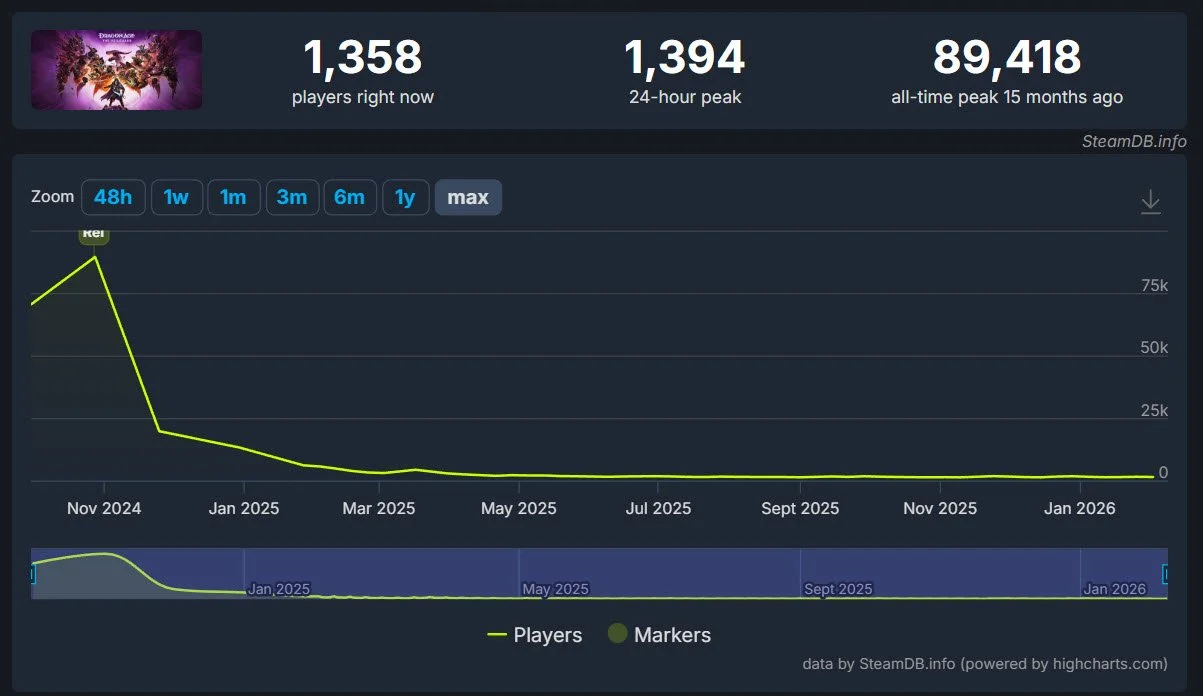
Where I’ll agree with Mr. Joy in his article is that when a game is considered doomed, it can be pretty difficult to recover. It’s possible, but the game has to have enough good qualities to overcome the label. When Electronic Arts/BioWare started releasing marketing for Dragon Age: The Veilguard, it was labeled “doomed” pretty quickly. While Mr. Joy would argue the game failed because of the label and because of the mockery it received from those negative Nancies, the content from the game was more than enough to speak for itself. Many potential players were disinterested immediately when the term “non-binary”—a term that has only appeared in our own modern vernacular within the past decade—was showing up in a high fantasy game that once had dialogue meant to sound like The Lord of the Rings. What would be the argument for the game not being “woke” with a term like that being tossed around in a pointless dinner scene that seems like nothing more than the writer’s projection of their own personal issues? Do you think a scene that conveys how transgressive it is to misgender someone, as a method of compelling speech, is appropriate for a video game that takes place in an established mystical universe? Steam charts showed how quickly the game fell off in interest after its release, and I’m certain just clips from these scenes were enough to turn more people off to the game than get them excited for it.
Would Justin Joy object to the term “woke” being used to describe Dragon Age: The Veilguard? If the argument were, “So what if it is?” then I’d say that you have to simply do a better job of making a product that people would want to play, that might still have elements that fit into the “woke” label. This can lead to a whole separate discussion that could go on forever, and I don’t want to get too off track, so I’ll wrap up the point quickly.
I’m essentially saying that had Dragon Age: The Veilguard used more subtlety and nuance in its storytelling, had the writing been better and similar in quality to the first game without compromising the world building, had the gameplay loop been more fun and engaging to those who played it, and had the marketing material not included instances of clunky dialogue and obvious ideological messaging, the game might not have been doomed. In fact, there might have been the alleged anti-woke players out there defending the game if it had hit all the right notes, even if they disagreed with the ideological affiliations of those involved with the development of the game. I’m sure some would stick by their political affiliation, regardless of the quality of the writing, and ignore all the positive qualities, and I wouldn’t be surprised if they foolishly dismissed the moment Eowyn says, “I am no man” in The Lord of the Rings: Return of the King as “woke.” But that doesn’t change the fact that Return of the King earned that scene. The Veilguard only earned its ridicule.
It’s All Concording to Plan
Now we’re getting into the section where he brings in his examples and defends them (or damns them with faint praise), starting with Concord.
“As much hate as it got, I genuinely enjoyed Concord. The biggest issue people had with the game was its character designs and $40 pricetag. The game was labeled “woke” and “uninspired” because of its character design, dialogue, and premise. But looking past that was a solid shooter that was fun to play, even in its beta phase. I admit I wished it had a stronger story and wasn’t a hero shooter, but the hate it received was way overblown, and it was a major part in the game failing. Had people given the game a chance, they may have discovered strong bones that could be strengthened through updates.”
For those who don’t know what Concord is or its significance in this conversation, I’ll give a little more context than is mentioned in Mr. Joy’s paragraph. Concord was an online-only hero shooter game developed by Firewalk Studios and published by Sony Interactive Entertainment; released on August 23, 2024. The game was reported to have a budget of $50 million back in 2019, though Firewalk claimed that the game only entered full production in 2022. $400 million was floated around as a number for the game’s budget, but developers denied that amount. However, if you think about how long the game was in production and the budget it had, along with the delays the Covid-19 pandemic caused, you can still guess that the budget was at least around $200 million. It got average reviews across the board from most of the game journalist outlets, including Eurogamer, which rated it three out of five, attributing the rating to the heroes' "muddled" character design: "The heroes seem to be visually either under- or overdesigned."
Why is all this info important? What does an average hero shooter with a large (but not unsurprising) budget have to do with anything? Well, upon release, Concord failed to exceed 700 simultaneous players. If you’ve been looking at the Steam Charts images I’ve provided so far, you know why that is catastrophically bad. Even Dragon Age: The Veilguard has more current players online at the time of writing this. On September 3, Sony announced that Concord would be taken offline and that all copies of the game that had been sold up to that point would be refunded. The game was delisted from digital storefronts, and its servers went offline on September 6, 2024. That means the game was released and online for no more than 14 days.
Concord has become the shining example of a game that died before it could walk, crawl, or even cry. It is the epitome of a game that was completely undone by its marketing to the point that no one had any interest. However, according to Justin Joy of Comicbook.com, the fault lies with gamers for being so hateful with their comments and not giving it a chance. You can still watch the reveal trailer or the gameplay trailer for yourself and determine if you think that’s a fair assessment.
In my opinion, there’s nothing about it that disgusts me, nor do the trailers scream “woke” to me, though some of the character designs do. In all honesty, it just looks bland and slow. As I mentioned, I’m not interested in hero shooters, so my bias towards it being dull should not be a surprise. The important thing is that it didn’t appeal to players who would play those types of games.
Compare Concord’s trailers to those of Overwatch (Cinematic & Gameplay), the game that popularized the genre. Overwatch’s trailers came out more than a decade ago, but they manage to make a far more compelling argument in both. The designs have a great deal more personality and diversity among them, making each character stand out. There are distinct aesthetics at play to make them attractive and interesting. The map in the gameplay trailer isn’t the most exciting to look at, but how the characters move around it, and its verticality showcase the speed of the gameplay, which comes across as much faster than Concord. The gameplay trailer also makes an effort to show off the different abilities and special moves of each character to give players an idea of the cool things they could do in the game.
When I compare the two, Overwatch—a nearly ten-year-old game—looks way better and more intriguing. The characters all have enough personality to them that I can immediately identify what type of characters they are and point to which of them I would be interested in trying. None of the characters in Concord’s trailers seemed interesting, nor did their abilities stand out as new or different. The Concord character designs weren’t just uninteresting; they didn’t do enough to help the player identify what they did in the game. Overwatch’s initial reveal video does a better job of establishing a lived-in world with history and lore to dig into, while Concord’s just looks like a Guardians of the Galaxy rip-off. Overwatch had pizazz and originality to it, but Concord came across as derivative and dull.
Returning to Justin Joy’s point about Concord, he admits that the game’s story is not interesting and that it probably wouldn’t have failed as hard as it did had it not been a hero shooter, a genre that is notably difficult to break into because of the already established popular titles demanding people’s attention. He claims that, looking past its uninspired character design, dialogue, and premise—which is a lot to look past—it was a “solid shooter that was fun to play.” That may be true, but he’s missing an important point.
There are plenty of solid shooters that are fun to play out there, countless of them, which look better and more interesting. Even stepping out of the hero shooter genre, thousands of first-person shooters have come out over the years, and are fun to play. What case are you making for players to hand over their money to play this? Several popular hero shooters are free-to-play, too, so Concord was already asking for money up-front while other popular games in the genre don’t. This is the issue with the $40 price tag that Mr. Joy fails to provide context about. It feels particularly revealing that he wouldn’t mention why $40 for a game was a sticking point when the average price for other games is $20 or $30 more.
If I give him the benefit of the doubt and just assume he forgot to mention why that price was a problem for a hero shooter, it doesn’t change the fact that the game still failed the basic transactional agreement with gamers. What case would you make to those who have the choice to go play other free games that this is more deserving of their money and time? Mr. Joy seems to think that these were elements that somehow contributed less to the failure of Concord than the online discussion about it. This extensive video sums up the various factors ignored by Mr. Joy in his article, and the video-maker even confessed to enjoying Concord from what little he got to play.
Justin Joy claims that the “hate” that Concord received was a major reason why the game failed. Meanwhile, I tend to agree with MRIXRT’s video that the poor management, uninspired character and game design, and inability to innovate to make the game more marketable to a current hero shooter audience were bigger reasons why the game failed. Again, this is the strategy of the Comicbook.com article to blame gamers for not supporting a game they don’t want without considering all the other important variables that can be attributed to the developer and publisher. If he weren’t so busy trying to absolve Firewalk Studios and Sony from their mistakes in the game’s development, he might be able to come to the conclusion the rest of us did.
Even if Concord had “strong bones” and had been approved publicly by gamers in its trailers enough to survive more than two weeks, I still don’t think it would have lasted long enough to get the updates Mr. Joy believes it could have. The fact is that Concord was a game made as a response to Blizzard’s Overwatch, but never evolved enough to warrant its existence, let alone compete with its inspiration. It started development well before the hero shooter genre became overpopulated, but didn’t change enough to keep up with market demands as more and more games came out, and was outdated by the time it was released. Popular games like Overwatch, Valorant, Apex Legends, Paladins, and the long-running Team Fortress 2 were already claiming such a big part of the market that other hero shooters like Battleborn, Lawbreakers, Crucible, and Rogue Company had already come and gone by the time Concord was released. It may have been a fun game and deserved to live longer than two weeks, but with such lackluster character designs and marketing, is it any surprise it failed to capture gamers’ interests?
A Star Wars: Outlaws Detour
Of the three games that Justin Joy chose as his examples to prove his point that genuinely good games fail due to negative first impressions, Star Wars: Outlaws is the most perplexing choice. It’s not because it isn’t a hero shooter. It’s a strange choice because, of the three, it’s the least defensible due to how thoroughly it has been documented to be a bad game.
“Star Wars Outlaws was unfairly judged on the reveal as well. People were more concerned about the protagonist’s appearance and hating on Ubisoft for actually acknowledging what looked to be a fun game. And at launch, sales were low, causing Ubisoft to cancel plans for it. But now, after several updates and DLC, the game is in one of the best places, and players are realizing it is a great game. If the hate train had slowed down during pre-launch and release, Star Wars Outlaws would be on a very different trajectory today.”
Nothing about Outlaws was unfairly judged, okay? That game looked bad from the start, with weird performance issues in the gameplay reveal alone. The protagonist, Kay, fell out of the same ugly tree as countless other female characters in modern Western-made games, but she’s not alone, as the rest of the game doesn’t exactly look good. Even ignoring character design, everything about the game seemed uninspired. Kay was so clearly meant to be a female Han Solo, a cosmetic skin of the protagonist wearing Solo’s clothes was a pre-order bonus. Yet any instance in which she’s meant to be a cunning and resourceful rogue in dialogue, she sounds like an insecure, millennial moron. When I saw her take out a stormtrooper by punching him in his helmet with her tiny, thin hands instead of just shooting him, I knew I didn’t need to take it seriously. I don’t know if Mr. Joy’s is just naive or not cynical enough to recognize when a game does not look good, but nothing about Outlaws’ gameplay reveal told me that it was something I needed to try.
When the game finally came out, countless videos popped up on YouTube showing how broken it was. There were weird performance issue videos. There were videos showing broken enemy AI, in which Kay could hide in a bush inches away from stormtroopers and shoot them without being found. There were videos of people falling through the world. It’s not impossible for broken games to still be good and find their audiences. Vampire: The Masquerade Bloodlines released in a notoriously broken state, but it had great writing, world-building, and quest design to make up for its flaws, and that came out 20 years ago in a much different market.
It’s a common occurrence these days for games to release in a suboptimal state, but that doesn’t excuse it, nor should we just accept that as normal and forgive the developers/publishers for releasing something that isn’t finished for a $70 pricetag, or even more. Justin Joy says that now that Outlaws has received its updates and DLC, it’s in “one of the best places.” I guess he hasn’t seen even a tiny amount of this video that explores all the different ways Outlaws is not just a broken game, but a horribly designed game as well.
Mauler’s breakdown is more than 17 hours long, so I wouldn’t expect anyone to watch the whole thing about a game they don’t care much about. However, it is still an exceptionally thorough video that does its best to cover all the different ways that Outlaws fails in its design as a product of entertainment. From the cliche storytelling to the characterization of Kay as anything other than an inept and horrible individual with the vernacular of a modern-day Californian, to clunky attempts at hiding loading screens, to having a speeder vehicle that barely functions as a mode of transportation, to an “open-world” game having invisible barriers that kill or reset you if you go too far off the intended path, it’s a pathetic failure of a video game.
Of all the various games Justin Joy could could have chosen as an example of a “genuinely good” game that failed due to negative attention surrounding it, I am baffled why Outlaws would be his choice—Dragon Age: The Veilguard was tagged in their article, even though he didn’t mention it, but maybe that was a bridge too far, even for him. I think it’s far more difficult to find examples of “genuinely good” games that were dead on arrival due to negative expectations and reception. Mr. Joy would have an easier argument to make if they used different examples of games that have gone on to have more support from fans post-launch, despite having negative first impressions. At the very least, they shouldn’t have chosen something like Star Wars: Outlaws. He could have chosen something that seemed to fail almost solely from its negative reputation.
For instance, I have seen some more convincing arguments in favor of games like Avowed, which had negative initial impressions and struggled at launch. Avowed is also a more appropriate example for the argument of the “woke” tag affecting the reception of the game. The marketing for the game turned many players off to the aesthetic of Avowed, like Concord. It also didn’t help that the art director behind the project decided to publicly criticize political figures and make dumb statements that added unnecessary, unwanted attention to his company. Still, I haven’t seen anyone make videos defending it like this.
At 2:59 in PatricianTV’s video, he says something that I think is too particularly appropriate not to include, which I’ll reference again later.
“The start of the game is Avowed's actual biggest issue in finding a meaningful player base that will actually talk about the game in 5 years. First impressions matter, and game devs have become so scared of players getting angry and never playing the game again that they have made games that are so boring, many people watching on a live stream will not check it out for themselves.”
While acknowledging its faults, PatricianTV defends the game and goes on to praise it in certain ways that make it more compelling than any of its official marketing did. There were plenty of instances in which YouTubers were mocking Avowed when it came out, but moreso because of the negative reputation surrounding its design and the public comments made by people in the development studio. Avowed’s launch was rough due to the negative perception surrounding it, just like the other examples that Justin Joy provided in his Comicbook.com article, but even the YouTuber defending Avowed still only calls it a “decent” game and not a “genuinely good” one. However, whose fault is it that there was such a negative reception around the game?
Star Wars: Outlaws didn’t have any controversy surrounding the political views of its developers prior to launch, nor was there an outcry of wokeness in its designs. The most that it had in the meta sense that could have seen as a potential mark against it was that it was an Ubisoft game that was following up an Assassin's Creed game, which also saw poor sales at launch. There was also the issue at launch regarding specific saved games…
Another common occurrence in the modern gaming industry that has continued to make me and countless others disgusted with it is the notion of the different “editions” of a game you can purchase at launch. Pay a little extra money for the game, and you can get some digital goodies that potentially offset the balance of the game’s design and collectable objects that are worth nothing! Ubisoft is notoriously one of the worst when it comes to this pricing model, often having more than three editions to choose from and requiring a spreadsheet to break down all the supposed benefits. Star Wars: Outlaws had the following purchasing options:
Standard Edition ($69.99): Includes the base game.
Gold Edition ($109.99): Base game, season pass (including 2 DLCs), "Jabba's Gambit" mission, and the Kessel Runner Character Pack.
Ultimate Edition ($129.99): Everything in the Gold Edition, plus the "Rogue Infiltrator" and "Sabacc Shark" cosmetic bundles for Kay and Nix, and a digital art book.
In addition to these options, there were retailer-specific deals as well:
Amazon Limited Edition: Includes the base game and the Rogue Infiltrator character pack.
GameStop Special Edition: Includes the base game and the Sabacc Shark character pack.
Target: Pre-orders included an exclusive steelbook.
Just looking at the list gives me a headache for several reasons, but there’s something missing from these descriptions. What isn’t mentioned is an additional bonus for people who purchased the Gold or Ultimate editions. One of the dumbest bonuses these special editions net you, which has become more popular since the term “FOMO” was coined, is the “early access” option. At some point, publishers realized they could charge people extra money just to give them the chance to play the game earlier than everyone else. Unfortunately for those who paid the extra coins to get early access, there was an issue at launch with the game. Ubisoft released a “day-one” patch that fixed several bugs and stability issues—certainly not all of them—but if players who had been playing the game for the 3 days before it became widely available to standard editions wanted to get the benefits of the patch, they had to start a new game and lose all their progress.
Justin Joy mentioned in his Comicbook.com article:
“...at launch, sales were low, causing Ubisoft to cancel plans for it. But now, after several updates and DLC, the game is in one of the best places, and players are realizing it is a great game. If the hate train had slowed down during pre-launch and release, Star Wars Outlaws would be on a very different trajectory today.”
While his statement is rather asinine when you break it down, because of course the game would be on a different trajectory if it hadn’t sucked so much at launch, I can’t say I’m surprised by what he’s saying. There are indeed people who have played it well after launch and are enjoying it. Good for them. I’m genuinely glad that people are getting real enjoyment out of the game. What Mr. Joy is not acknowledging in his statement, however, is the question of why Outlaws failed at launch, throwing it off a positive trajectory, and who is really to blame.
There’s an acknowledgement that sales at launch were low, which made Ubisoft cancel further updates to the game after its promised roadmap was completed. It’s also recognized that it took several updates and DLC to get the game to “one of the best places.” I have a few questions. If the launch of the game is so important to determine whether or not your game succeeds, why release it in such a state that is sure to invite mockery and derision? Why should gamers wait for update after update and patch after patch for the game to finally be in a good enough state to be fun?
It has become a normal occurrence with games, in which they launch in states that require extensive updates and patches. It’s part of the reason I stopped buying games when they were new. If I’m going to have a bad time during the early stages of the game’s life cycle, then I’ll just wait until all of its updates are out and the thing is finally in a good state. Yet, according to Justin Joy, it’s the gamers’ fault for not rushing out and buying the game at launch, despite all the evidence they saw that Outlaws was not very good. Maybe all those Outlaws players who were dissatisfied with their launch experience should have only bought the game and then waited a year to actually play it. That way, Ubisoft would have gotten its money and seen better sales figures to stay the original course of support, and the players’ initial impressions wouldn’t have been so negative. Seems perfectly reasonable, right?
As has been said, and I will keep saying in my lengthy response, first impressions matter a lot with a video game. A game needs to wow people enough that they would be convinced to pay the $70+ pricetag to play it when it’s new. It needs to wow them enough to convince them to stop playing any of their countless other games that are entertaining them right now in favor of this one. Ubisoft knows this because ordinary people like me know this. If they want those big sales at launch, they need to create something cool and fun, and they need to market it well enough to get fans excited. Ubisoft knows that on release day, countless streamers on YouTube are going to play their game, and it will be shown to millions of potential other buyers who will gauge the experience based on what they are seeing and determine for themselves if the game is worth the price. If the game looks like a broken piece of trash with bad design choices or lame characters, I ask again: whose fault is that?
To bring this detour to a close, simply put, Star Wars: Outlaws deserved to fail. It had countless issues when it released. The stealth, combat, and traversal didn’t look interesting or even functional. The characters didn’t seem likable. The world-building was shallow. Gamers could see all of this on YouTube within the first week of its launch, and they didn’t need to say a word to anyone else for it to fail as a result. As much as game journalists tried to defend it and deflect criticism, the footage online was more than enough to convince people the game wasn’t worth their time or money. Outlaws was a game that failed on its own merits.
The Mistakes of Highguard
At last, we come to Highguard, the game that likely inspired the Comicbook.com article in the first place. Ironically enough, another game has been revealed since the article was published that would fit right into the argument, but we’ll get to that later. Of the three games Justin Joy uses as examples, this is probably the most defensible. However, there are other contributing factors as to why it’s having such a tough launch that he does not mention.
“And now Highguard is taking similar hits, with entire threads dedicated to predicting its failure before the game even launched. And with its release, the hate is only building despite many people praising it. Don’t get me wrong, Highguard deserves its criticisms and should have been an early access game, people are unfairly judging it. People are calling it terrible without fully understanding the gameplay loop. I understand providing feedback, but that criticism should be constructive, not destructive.”
Of the various paragraphs in this section, I take the least issue with this one. I agree that it probably should been in early access instead of launching as it did, especially because in their panic to retain the few players they have, the developers have drastically changed the mechanics in the game to have more players on a map at a time than they originally planned. This shows they didn’t necessarily have a plan for the game’s launch or what would be required to keep the game alive.
I also agree that criticism should be constructive instead of destructive. Of the criticism I’ve seen, the harsh critics are exceptionally negative towards it, but I’ve also seen plenty of feedback that probably would have been useful to the developers well ahead of their release date. There’s definitely an element of schadenfreude to the game’s downfall because of what Highguard seems to represent to the general gaming public.
Even though some of the criticism seems needlessly excessive, including from those Justin Joy believes didn’t play it enough to fully understand the gameplay loop, the defense is not much better. Those defending the game do so without much acknowledgement of the other factors at play, like the lack of visual style or the crowded market of free-to-play games and hero shooters. The defense is more like a denial that there weren’t other things wrong with the game’s release than just mean gamers allegedly wishing for its failure.
The game was just not ready for the public and would have benefited from some early criticism in its development from players. Many of the developers came from Apex Legends, another hero shooter that is still doing well since it released years ago. It also launched in a way that worked really well for it in that it happened without any big marketing pushes or open betas beforehand. It was just suddenly available and made for a pleasant surprise to many players, allowing it to grow in popularity through word of mouth. Highguard was on track to do the same thing, which meant that the public was not aware of its development and would only see it on launch day. However, the plan changed slightly and is part of the reason why the game and development studio are in trouble.
Perhaps the biggest mistake for Highguard was one that would normally be a big opportunity for an upcoming game. Highguard’s presence at the 2025 Video Game Awards amplified expectations for it. It was not only revealed at the awards, but it was also given the spot normally reserved for the biggest announcement of the night. The show’s host and owner, Geoff Kealey, had played Highguard ahead of time and was so enthusiastic that he gave the advertisement spot to the developers for free—a spot that usually costs millions of dollars per minute.
It was a generous gesture from Kealey and a sign that he believed in the product, but he, like the developers at Wildlight Studios, did not anticipate the reaction to Highguard’s style or how the general public might react to the announcement of another hero shooter in this coveted spot.
[UPDATE] Since the publication of this article, it’s been reported that Wildlight Studios might have been funded through a subsidiary of TenCent, the Chinese conglomerate that owns significant portions of game studios, including Riot Games and Ubisoft. It could then be implied that Kealey’s decision to offer the spot “for free” may have had different motivations and benefits, but I am merely speculating without evidence.
I watched the awards through PatricianTV’s stream, in which he mostly ignored what was going on—that was more entertaining to me than actually watching a show that was all about trailers for upcoming games. When Highguard appeared, he and his co-host, PrivateSessions, reacted with the same bored disinterest as I did.
I think the added attention actually hurt the game’s chances. Laura Fryer, a developer veteran who shipped countless AAA games, including Gears of War, agreed in her recent video about Highguard.
If all you saw of Highguard was the image in Laura Fryer’s video thumbnail, would you think it was worth checking out? The trailer just didn’t make the game look good. The environments looked okay, but the characters had a similar Concord problem in that their designs didn’t do enough to make them pop. Many don’t like to admit it for some reason, but how games look is important. Sure, there are games like Undertale that take a very minimalist aesthetic, with the focus placed more on the experience through the gameplay and story, but with certain genres, style is everything. Laura Fryer says as much in her Highguard and Concord videos about how important the characters' look is in a hero shooter. Similar to fighting games, when you are giving players a choice of characters to control, you have to make the player feel cool and powerful while they do it.
Again, first impressions matter a lot with video games, and if your trailer is going to be the first thing someone sees of your game, it needs to look cool to grab players’ attention. Otherwise, it could backfire significantly. Cyberpunk 2077 had a rough launch for a number of reasons, but it was a high-profile blunder because expectations had been set so high by how cool the game looked in its E3 2018 trailer. It’s a great trailer that oozes with style and moves with the music that has an edgy and dark tone to prepare you for Night City. It was the first significant chunk of footage anyone saw of the game, and it immediately got a lot of people’s attention. Highguard’s trailer didn’t have enough to spark interest or even really explain what it was. Even Wildlight’s CEO, Dusty Welch, acknowledged as much in a recent interview:
“We didn't do a great job with our trailer ... We own that.”
The interview with Dusty Welch was published on the same day as Justin Joy’s article for Comicbook.com, so we can’t expect him to have seen Welch’s comments prior to writing his article. However, if the CEO of Wildlight is willing to admit it wasn’t a great trailer, why wear the veil of surprise that Highguard is taking a hit from the public? It was clear to me that there wasn’t enough in that trailer to get me or anyone I knew excited. It was clear to streamers that the trailer was not particularly exciting enough to be in the final spot at the Game Awards. And it was clear to the CEO that they could have done better. Why wasn’t it clear to Comicbook.com’s writer, who is willing to say that the game “deserves its criticisms” but isn’t able to see why players are anticipating its demise? Something tells me he’s not that blind or naive, just simply determined to play his part in the game industry.
End of Part 2
That’s the end of the second article that I thought would be the other half of the story. However, due to a recent announcement by Sony, I felt compelled to break things up further to tackle that matter as well in my closing counterargument to the Comicbook.com article. Come back later this week for Part 3.