It's Gamers’ Fault? | A Response to Comicbook.com's Idiotic Article About the Video Game Industry
It’s been a while since I responded to an inane and erroneous article about video games written by a “journalist” who somehow manages to have unfounded opinions, but here we are once again. My response to Kotaku’s non-review review of Hogwarts Legacy was based on the author’s opinion of a single game and their political/social affiliations. I took issue with the writer’s prejudice towards the game based on their opinion of the source material’s author, as well as their arrogant perspective about the role of games' “journalists” in the industry. It was a somewhat dense review—though it claimed not to be a review as a deflection method—filled with a lot of dumb statements to comb through. This time, the article I’ll be responding to is much shorter, but still just as one-sidedly stupid, so it’s going to be a long response.
I happened to be scrolling through my news app, and an article appeared with a very clickbait title that I still selected because of how stupid it was:

I knew I was going to disagree in some way because that title just sets everything up to fail. I just wasn’t aware how much I would disagree, especially considering I have rarely ever visited Comicbook.com and am not familiar with the general opinions of that website.
As my preamble and the title of the article suggest, the site seems to be just as bad as Kotaku and all the other media shill websites out there that will do whatever they can to maintain their access and so-called status in their industry, even if the means pushing delusional perspectives. When Lucasfilm crapped out one bad Star Wars project after another, they’d attack the fans and call them toxic bigots rather than admit that they made any mistakes, while the corporate magazines like Variety and The Hollywood Reporter parroted the company’s messaging without an ounce of integrity. It’s a strategy that was used again and again by entertainment companies to avoid accountability for being terrible at their jobs, and only managed to push away the interests of the public in the process. So, of course, that line of thinking eventually made its way into the video game industry as well.
This article that I’m about to discuss is not a response to any single press release from a company, but it was likely inspired by the recent troubling launch of Highguard, the free-to-play shooter that was revealed at the end of the ever more irrelevant Game Awards show in 2025. I have no evidence that the Comicbook.com author was hired to gaslight and strawman, or if they were personally compelled to convince the world that it’s the fault of the consumer that certain games fail. I just know that if they genuinely believe the points of view they share in their article, they have a very warped view of reality.
Below, I’ve included the text from their article in the accordion for the sake of backing up the content and convenience, but you can click this link to go directly to the article to see for yourself. (I’m not trying to draw traffic away from their site, just insult their logic.) I will, of course, be including quotes and responding to each paragraph as we go along.
While I will be rather blunt at times towards the author’s opinions and logic, and as much as I disagree with him, I’m not trying to make it personal. This is merely a lengthy response to an opinion I have seen far too many times, and I want to shut it down with my own argument. Let’s get started.
-
There is a growing problem in modern gaming culture that is impossible to ignore. I see it every time I watch a PlayStation showcase, a Nintendo Direct, or any other gaming-related stream. The gaming industry is bigger, and expectations are higher. And with the internet being more readily available than ever, there is a bigger scrutiny on upcoming and newly released games. Together, these have led to an increase in the negative ways gamers interact with developers.
The atmosphere in the gaming industry has shifted from questioning to outright hostility. I’m used to skepticism or cautious optimism, but now, players take every opportunity to trash a game, even if they’ve only seen a few minutes of gameplay through a reveal trailer. Gamers are calling a game doomed before it even launches, which negatively impacts its sales, sometimes even causing it to fail entirely. This isn’t to say every game fails because of bad press and negative word of mouth, but to completely write a game off without trying it has seemingly become the norm for a majority of people who supposedly love video games.
Gamers Are More Excited for a Game to Fail Than Succeed
At some point, cheering for a game’s downfall became entertainment. Whether the cause is influencer culture, social media hot takes, or the algorithm’s hunger for negativity, the outcome is the same. The loudest voices online often seem to revel in failure. You can see this during any major livestream. It happened during the PlayStation State of Play when Concord was revealed. It happened during the Ubisoft Forward when Star Wars Outlaws gameplay was shown. And more recently, Highguard fell prey to this same toxic pattern when it was revealed as the closer for 2025’s The Game Awards.
During these types of streams, the live chat scrolls by in a blur of dismissive comments. “Dead game.” “No one asked for this.” “Looks trash.” “Already failed.” “Woke.” These reactions appear within seconds, long before players have even seen the full gameplay loop, let alone touched the controller themselves. Somehow, within just a few seconds, gamers suddenly know whether a game is good or not. This culture of putting down games has overtaken a hobby that should be played for love and enjoyment.
This culture does not just hurt developers but gaming communities as well. It creates an environment where people are more interested in being right about a prediction than in enjoying something new. I’ve seen so many subreddits turn into debates about whether a game is bad or people are just hating on it because that is the popular opinion. Even when people prove they enjoy a game and it has its merits, these opinions are outright dismissed, and the hate keeps on going.
Sometimes Good Games Get Set Up for Failure
The most painful part of this trend is that genuinely good games get steamrolled by bad expectations, many times before they even launch. A title can have a strong core loop, fun gameplay, or a truly passionate development team, yet still collapse under the weight of online negativity. This perception death causes a game to be labeled as doomed, and it can be nearly impossible to recover from this. Several games have fallen to this negative practice, and many of them didn’t deserve it.
As much hate as it got, I genuinely enjoyed Concord. The biggest issue people had with the game was its character designs and $40 pricetag. The game was labeled “woke” and “uninspired” because of its character design, dialogue, and premise. But looking past that was a solid shooter that was fun to play, even in its beta phase. I admit I wished it had a stronger story and wasn’t a hero shooter, but the hate it received was way overblown, and it was a major part in the game failing. Had people given the game a chance, they may have discovered strong bones that could be strengthened through updates.
Star Wars Outlaws was unfairly judged on the reveal as well. People were more concerned about the protagonist’s appearance and hating on Ubisoft for actually acknowledging what looked to be a fun game. And at launch, sales were low, causing Ubisoft to cancel plans for it. But now, after several updates and DLC, the game is in one of the best places, and players are realizing it is a great game. If the hate train had slowed down during pre-launch and release, Star Wars Outlaws would be on a very different trajectory today.
And now Highguard is taking similar hits, with entire threads dedicated to predicting its failure before the game even launched. And with its release, the hate is only building despite many people praising it. Don’t get me wrong, Highguard deserves its criticisms and should have been an early access game, people are unfairly judging it. People are calling it terrible without fully understanding the gameplay loop. I understand providing feedback, but that criticism should be constructive, not destructive.
Why Do Some Gamers Hate Video Games So Much?
The question I keep returning to is, why does this happen? Why do so many gamers appear to dislike video games and want them to fail? Players are quick to jump into online streams or forums to bash games, often without even having played them. Critiquing is one thing, but the cynicism that is prevalent in today’s discussions goes beyond this. It just seems like some people aren’t happy unless a game fails, even if it’s one they have no intention of playing.
Part of it comes from being burned. Launch disasters like Cyberpunk 2077, inconsistent live service models, and rising prices have created a climate of distrust and frustration. These are valid to a degree, but this doesn’t give gamers cause to destroy a game before it even hits release. But this has become a popular practice, and the internet rewards this behavior. A negative post gets more engagement than a positive one. Influencers build entire brands around pessimism, and content creators who call a game dead in the thumbnail get more clicks. And these voices calling a game dead are often the loudest, even if they belong to a minority.
The thing is, no developer, at least a serious one, sets out to create a bad game. They want players to enjoy the worlds they build. But the culture surrounding game launches makes it harder for them to succeed. When audiences decide a game is bad before release, when livestream chats drown out excitement with mockery, and when negativity becomes the default, developers lose the chance to grow their communities naturally. This is not to say criticism is wrong because critique and player feedback are essential. Honest opinions help shape better games, but there is a difference between criticism and cynicism.
Unless gamers recognize their role in shaping this negative culture, the cycle of hate will continue. Developers will stop taking risks, and creativity will be stifled. Gamers don’t have to blindly praise a game, but they should give a title a chance before badmouthing it. It takes no energy to see a game, realize it isn’t for you, and move on without adding to the commentary. If this negative mentality continues, the gaming industry may face a problem it can’t beat, and the ones who will suffer for it most are gamers, those who partake in the destructive discussion, and those who don’t.
The Vague Growing Problem
“There is a growing problem in modern gaming culture that is impossible to ignore. I see it every time I watch a PlayStation showcase, a Nintendo Direct, or any other gaming-related stream. The gaming industry is bigger, and expectations are higher. And with the internet being more readily available than ever, there is a bigger scrutiny on upcoming and newly released games. Together, these have led to an increase in the negative ways gamers interact with developers.”
Immediately, I find myself disagreeing with the author, but not in the traditional sense. I agree that there is a growing problem. In fact, I think there are many growing problems leading towards disaster in the gaming industry, but it’s not coming directly from gamers. Of course, the author of this piece is probably not aware of what I mean and would rather point the blame elsewhere, but that’s the point of their article in the first place. It’s the wording of the final three sentences where I struggle to understand what he’s saying.
He seems to be suggesting that expectations for games have increased, which is somehow tied to the size of the industry. I can sort of see where he’s coming from, even if I don’t quite agree with the logic, if that’s the case. But it’s a vague statement, so I can only assume. If we’re to extrapolate the statement and go a little further, perhaps he’s saying that now that the gaming industry is bigger than any other entertainment industry, there are countless different games out there trying to stand out. If the author is trying to say, “Games made with large development teams and million-dollar budgets have higher expectations of being good than indie games with smaller teams and budgets,” I’d say that’s a fair statement. If he’s trying to say, “It’s a crowded market of games of all different genres, vying for gamers’ time and money,” I’d also agree. I don’t necessarily think that equals “expectations,” but it’s reasonable to believe that in order to expect gamers to notice a game in a positive way, it has to stand out in a dense market. (Not to spoil my argument, but this sounds like it’s not the gamers’ fault…)
The second sentence has a similar vagueness to it that doesn’t make sense and is more weirdly worded. I don’t understand how the “readiness” of the internet makes scrutiny “bigger.” Is “readiness” meant to insinuate an eagerness to criticize? What he says later on would lead me to believe so, I suppose. Does he mean that people are more eager to see the next big thing? I don’t quite get what he means here.
The final sentence then claims that the readily available internet and the high expectations “have led to an increase in the negative ways gamers interact with developers.” Well, this is true, but let’s be fair. The internet has led to an increase in the way gamers can interact with developers entirely. Growing up in the ‘90s, I didn’t have a way of expressing excitement or concern to developers when I saw previews of their games in magazines. I just had to take the word of the journalist who was at the company event or E3, and assume they were telling me the truth when they described things. Eventually, there were forums, social media, and things like Reddit that hit the scene in some shape or form, but before then, only journalists could provide opinions about the game to the developers, and they could only look at the sales numbers to determine if players liked the game or not. With the internet today, there is a direct line from the consumer to the developers like never before (which is probably part of the reason the modern journalists are so quick to try to shut everyone else up). The final sentence of this paragraph suggests that customers having direct communication with developers has not led to positive interactions or positive results. I guess the intention of those statements is, “It’s only negative, and gamers should just shut up.”
We’re off to a bad start. Unfortunately, the second paragraph gets much worse…
“The atmosphere in the gaming industry has shifted from questioning to outright hostility. I’m used to skepticism or cautious optimism, but now, players take every opportunity to trash a game, even if they’ve only seen a few minutes of gameplay through a reveal trailer. Gamers are calling a game doomed before it even launches, which negatively impacts its sales, sometimes even causing it to fail entirely. This isn’t to say every game fails because of bad press and negative word of mouth, but to completely write a game off without trying it has seemingly become the norm for a majority of people who supposedly love video games.”
The atmosphere has certainly shifted in the industry, but I would not go so far as to call it hostile, as though there is no positivity to be found. I’d call the atmosphere more downtrodden and skeptical than anything else, and that’s really more towards the large Western game developers and publishers, not indie studios or even some Eastern companies. I’ll concede that there’s plenty of reason to be hostile, however.
For years, we’ve seen how most AAA games have gotten more expensive and offered less meaningful experiences. Most of the creativity in the development of those games is spent on coming up with ways to further monetize the experience and nickel-and-dime the consumer with add-ons and downloadable content. If you’re going to charge $60, $70, or more for a game, and then charge even more with additional content after the fact, why shouldn’t gamers be skeptical or even hostile? If you’re going to offer a live-service game for free and then bombard players with microtransactions that have been specifically designed to prey on behavioral psychology, why shouldn’t they be skeptical or hostile? If you aren’t aware of this practice, I recommend clicking the link or watching just the first few seconds of the video below to get what I mean.
I know I mentioned Western companies as being deserving of scrutiny for their business practices these days, but it’s not like Eastern publishers aren’t guilty of similar practices. I didn’t buy a Capcom game for years after I felt shortchanged by them when they released a new version of Marvel vs Capcom 3 with a larger roster within a few months of the initial version and charged $40 for it, and that was more than a decade ago. While Capcom has improved in some ways, there’s plenty to complain about how they do things, including the monetization of cosmetics in their games (i.e., Ninja Turtles cosmetics in Street Fighter 6).
Regardless of whether there is hostility between corporations and consumers, whose fault is that? I’d argue it’s the responsibility of the game developers and publishers to cultivate a positive atmosphere by making products that the public would want to purchase and treating their customers with respect. There are plenty of instances in which developers outright lied to their customers with trailers (i.e., Naughty Dog and The Last of Us Part 2), so why shouldn’t they have opinions of a game they haven’t played yet? Gamers are not beholden to these corporations to just always be enthusiastic or hand over their money. It’s their right to have an opinion on something or to call it “doomed” without playing it.
I write off games and movies all the time based on trailers because the trailers failed to make me interested. After all, the whole point of a trailer is to capture the customer's interest! If it fails to do so, whose fault is that? It’s not the customer’s. If an industry has consistently failed to capture the interest of the customer or mislead its audience year after year, again, I’d argue that’s not the customer’s fault. Justin Joy is seemingly making the argument that gamers shouldn’t be allowed to be negative towards billion-dollar companies because being negative is mean, and being mean is bad.
So, we’ve already spent a lot of time on just the opening paragraphs that are full of vague but accusatory statements suggesting that gamers are too negative, and that, by extension, is making the gaming industry worse, without acknowledging the faults of the corporations. To extrapolate further, Mr. Joy seems to be suggesting that if gamers didn’t write off products that didn’t interest them and stayed positive, games and the industry as a whole would improve because fewer games would “fail.” I suppose they’re right that fewer games would fail if people just kept buying everything that came out, as though money and time were not finite resources for the average person.
What I’m getting at is that just in the first two paragraphs and with the title of the article, the Comicbook.com author is taking a stance on the side of the large corporations—not indie developers because they’re never mentioned in this article—against the consumer, with a pretentious tone of sneering down his nose at the foolish peasants who would dare be dissatisfied with the slop being fed to them. This is a very anti-consumer article, and it only gets worse with the subsequent sections that espouse nonsensical statements without evidence or consideration for the opposing argument.
Do You Know What “Excited” Means?
The title of his next section is already pretty charged and stupid before he even gets into the meat of what he means. Again, it’s taking a firm stance that gamers are just negative Nancies who are more entertained by games failing than playing good games, as though schadenfreude was the only way for the modern gamer to get excited. It’s just patently untrue, and I can prove it with a simple video, but we’ll get to that.
“Gamers Are More Excited for a Game to Fail Than Succeed
At some point, cheering for a game’s downfall became entertainment. Whether the cause is influencer culture, social media hot takes, or the algorithm’s hunger for negativity, the outcome is the same. The loudest voices online often seem to revel in failure. You can see this during any major livestream. It happened during the PlayStation State of Play when Concord was revealed. It happened during the Ubisoft Forward when Star Wars Outlaws gameplay was shown. And more recently, Highguard fell prey to this same toxic pattern when it was revealed as the closer for 2025’s The Game Awards.”
All of the games he mentioned in this paragraph were indeed games that fell on hard times during their launch period. Do you know what else they had in common? Games and trailers that failed to generate interest in the market. As he’ll go on to acknowledge later, Concord and Star Wars Outlaws had issues with their presentation that rubbed players the wrong way. Highguard, I would argue, has less of an “ugliness” problem and more of a bland problem with its appearance. Still, it didn’t bring enough to its reveal trailer to make gamers think it was the next big thing to try because it was yet another entry in a very crowded and oversaturated market.
I think the selection of games this author chose to highlight in the first paragraph of this section as examples of his point is pretty funny. We’ll certainly get into them more in the next section of his article because there’s plenty to be said. I just want to bring your attention back to where he claims he saw an instance of intense negativity. He says, “It happened during the PlayStation State of Play when Concord was revealed.” The sentence is almost suggesting that this thing happens all the time on PlayStation’s streams because, according to the author, “Gamers are more excited for a game to fail than succeed.” They must just tune in to these live streams to hate on new game announcements, right? Well, I have a perfect counterexample that shows how people can get excited with a game’s trailer. And wouldn’t you know it, it was revealed at the end of a PlayStation State of Play stream. You tell me if the streamers and their chat are not genuinely excited. I certainly was when I saw it for the first time.
I guess Mr. Joy of Comicbook.com missed this reveal and reactions. Maybe he’s watching the wrong streams or looking at the wrong chats because look at what he says next.
“During these types of streams, the live chat scrolls by in a blur of dismissive comments. “Dead game.” “No one asked for this.” “Looks trash.” “Already failed.” “Woke.” These reactions appear within seconds, long before players have even seen the full gameplay loop, let alone touched the controller themselves. Somehow, within just a few seconds, gamers suddenly know whether a game is good or not. This culture of putting down games has overtaken a hobby that should be played for love and enjoyment.”
The horror! How dare skeptical gamers share their dismissive comments! Perhaps we should censor their hate speech so that we only have toxic positivity in our community. Nothing bad has ever come from that, right?
Obviously, I’m not saying that gamers SHOULD always be negative about something or that they shouldn’t give something a chance that they might have originally written off. I’m just saying that they have every right to voice their opinions, regardless of whether they’ve played the game. If the game’s trailer doesn’t look interesting to them, they have a right to say it “looks trash.” If a game like Highguard takes the final trailer slot at the Game Awards, which is often reserved for the most anticipated upcoming game due to a studio’s pedigree or rumored hype, and then it looks like another generic hero shooter with relatively bland designs, why shouldn’t some view it as a dead game? They’re predicting that the market will respond to it the same way that they’re reacting: with disinterest. So long as there are platforms in which people can voice their concerns without censorship, people will do so—and they should have every right to do so, in my opinion. To tie this back into what I said earlier about how things were before the internet gave a voice to customers, it seems like this writer wishes it would go back to the “good times” when only journalists were able to talk directly to developers: Why can’t we just go back to the way things were when I had more power and influence than the filthy proletariat?
As for a game being “woke,” I’ll extend an olive branch to Justin Joy that I think the term has become too overused to always be accurately applied until a person has played or seen a significant portion of a game or movie. There are games like Relooted, Dustborn, and Dragon Age: The Veilguard that wear their messaging on their sleeve, of course. But some games get the tag attached simply because it’s easier to label them as such. For instance, I saw the term being used to describe the story of Silent Hill f because of how the plot centered on a female character rejecting the cultural norms of her society, but I’d argue that there is a little more depth to the argument within the game’s story and how the argument is presented. Still, people can call it “woke” if that’s how they interpret the experience, as is their right, even though I disagree. Regardless, when I look at the Highguard trailer, I don’t see what is commonly classified as “woke,” just a generic shooter with some people of darker skin tones than whipping cream.
Getting back to the article, the last two sentences in the paragraph are where the Comicbook.com author’s antipathy rears its head.
“Somehow, within just a few seconds, gamers suddenly know whether a game is good or not. This culture of putting down games has overtaken a hobby that should be played for love and enjoyment.”
The use of “somehow” to express their disbelief that people might form opinions so quickly, the redundancy of “within just a few seconds” and “suddenly,” and the assertion that gamers “know whether a game is good or not” all contribute to this author’s apparent disgust for the average stream viewer who might be disappointed by what they see on screen and feel the need to share those feelings. No one really knows for certain whether something is good or not until they try it for themselves. However, that doesn’t mean they aren’t allowed to have an opinion or that their opinions don’t matter.
When I saw the trailers for Concord and Highguard, I knew they were of the hero shooter genre—a genre that does not interest me. So, I immediately wrote them off on that reason alone. The games didn’t appeal to me on a gameplay level, let alone the fact that I didn’t see anything visually interesting. What about a game I should like? When I saw the gameplay for the upcoming James Bond game made by the developers of the Hitman games, I was underwhelmed. It should be a game that appeals to me: I’m a James Bond fan and a Hitman fan. Still, what they have shown me has left me feeling skeptical and wondering if the developers are going to take all the wrong lessons of modernity from the more recent Bond movies that suck in their implementation of the character and story. I still don’t know if the game will actually be good, but am I not allowed to be disappointed or worried by what I have seen so far? Am I supposed to just buy the game because I like James Bond and other IOI games, under the assumption they’ll give me what I want?
Sometimes developers just miss the mark; that’s not the fault of the customers. When the Blizzard developers at BlizzCon 2018 announced a mobile Diablo game, they were booed by their crowd of PC gamers who wanted a new Diablo game on their computer, where Diablo has traditionally been available. They had made a bold choice to take one of their established brands and put it on a different platform, which is also somewhat stigmatized by those who play games on PCs or consoles. What did the developers do in response to their potential customers’ reaction? Did they humbly try to appeal to the audience by explaining how they worked really hard to make the game more accessible on the go? Did they say how they were going to use the feedback from this event and the reception of the game to improve the next project? Nope.
Rather than making a better case for their decision regarding Diablo, they indignantly responded to the crowd, “Do you not have phones?” No one in the crowd explicitly knew whether Diablo would be good or bad on the phone, but that’s not important or why they booed. It simply was not what they wanted, and the developers were shown to be out of touch with their audience of potential customers.
Delusions of Hatred
In the Comicbook.com article, the author’s final line in the second paragraph of their “Gamers Are More Excited for a Game to Fail Than Succeed” section then suggests that “putting down games” has overtaken the hobby as a whole. One, that’s a hyperbolic way of looking at stream chats. Two, what evidence do you have to suggest that these heathens that are saying such meany mean words don’t still play other games that bring them enjoyment? Simply look at the Steam Charts, and you’ll see plenty of games with an active player base that were made by developers with a similar level of prestige or backing as Highguard, Concord, or Star Wars: Outlaws. You’ll also see plenty of games made by smaller developers, like Terraria or Stardew Valley, which have had more players in the last 24 hours at the time of writing this article than Highguard ever got. I guess people are just playing those games because they hate them so much, right?
“This culture does not just hurt developers but gaming communities as well. It creates an environment where people are more interested in being right about a prediction than in enjoying something new. I’ve seen so many subreddits turn into debates about whether a game is bad or people are just hating on it because that is the popular opinion. Even when people prove they enjoy a game and it has its merits, these opinions are outright dismissed, and the hate keeps on going.”
This is such a childish way of looking at comments. The first sentence suggests that negative comments have no positive effects on game development or the community surrounding games. There are plenty of instances in which criticism—regardless of how harsh—led the creators of media to pivot and avert complete disaster. I shared an example regarding the Sonic the Hedgehog movie in my Lily Gao article from a few years ago, but I’ll stick with games this time.
One example that immediately comes to mind is the meta story about Helldivers 2. This was a game with a lot of backing behind it that blew up in popularity, seemingly overnight. It was at the top of the Steam Charts for a while, and there was an extensive amount of buzz about it being a fresh and innovative new third-person shooter. According to Steam Charts, it peaked at 458,709 concurrent players two years ago. Now, it has a 24-hour average of less than 25% of that. That’s a sharp decline that would make sense with time in some ways, but that decline was made sharper and spurred on by the incident involving Sony.
When Helldivers 2 first launched, it was available on PC and PS5 and was a smash hit. Unbeknownst to its PC playerbase, they were in the middle of a hidden grace period because in May of 2024, they suddenly were told they had to create or sync their PlayStation Network accounts with their Steam accounts to play the game. Not only does this not make sense for people who did not own a PlayStation device, but Sony also doesn’t exactly have the best track record when it comes to the security of their network, so I can understand why people would not want to do this. As someone who hates having to sign up for accounts for pretty much everything in our digital world, I would be reluctant, too. This unnecessary step that was added onto the experience for no reason outside of contractual obligation with Sony caused many PC players to drop the game. It harmed the game’s community and the developers’ reputation far more than the negative comments of fans, even after Sony walked back their initial plan.
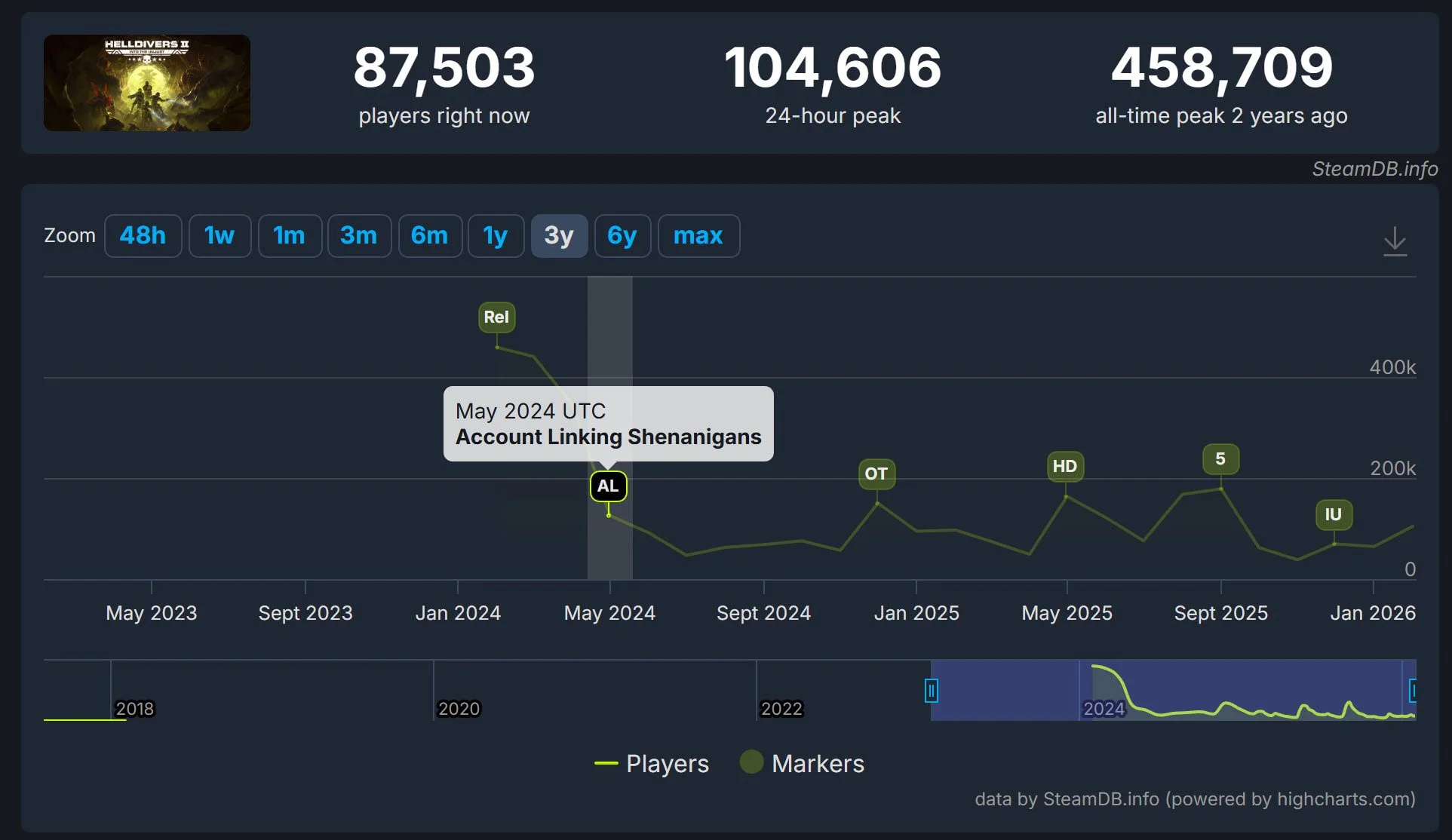
Gamers were pretty enthusiastic and loving towards Helldivers 2 when it first came out. Should they have just shut up and not complained when they were given a bait-and-switch by a big corporation? It’s clear that their “outright hostility” towards Sony’s actions made the company reconsider the initial plan. Do you think that was a bad thing? Do you think it would have been better for the game and the community if they just kept their negativity to themselves? I bet that had gamers not complained, they still would have silently left in droves, and both Sony and Arrowhead Games Studios would have been shocked by the sudden downturn in players. They just wouldn’t have had such a clear outcry to point to as the reason why their game suddenly collapsed overnight.
The reality is that they listened to the righteous anger of their customers and walked back their initial decisions. The game has never fully recovered and will unlikely ever reach its previous heights, but as of just a few days before writing this article, the 24-hour peak average of the week jumped from approximately 60,000 players to more than 100,000, which says the game is still alive and healthy enough to continue with updates and support. I sincerely doubt that would still have been the case had Sony and Arrowhead ignored their customers; they saved the game from total annihilation and made a product that people still wanted to play. The hate didn’t “keep on going.”
What about when a player base is not as vocal about their disappointment? What happens to games that aren’t in the Helldivers scenario? Ever since the successful release of the ninth main game in the franchise, Mortal Kombat has received an increase in popularity in the fighting game community. Mortal Kombat 11, released in 2019, set a new franchise record for sales by achieving 15 million copies sold by 2022 and more than 73 million units sold worldwide since 2019. That is massive success for a fighting game, which is typically a rather niche market. The follow-up and latest entry in the series, Mortal Kombat 1 released in 2023 and has sold more than 6 million copies so far, which is still pretty successful. How is the community doing for it right now in comparison to its previous entries?
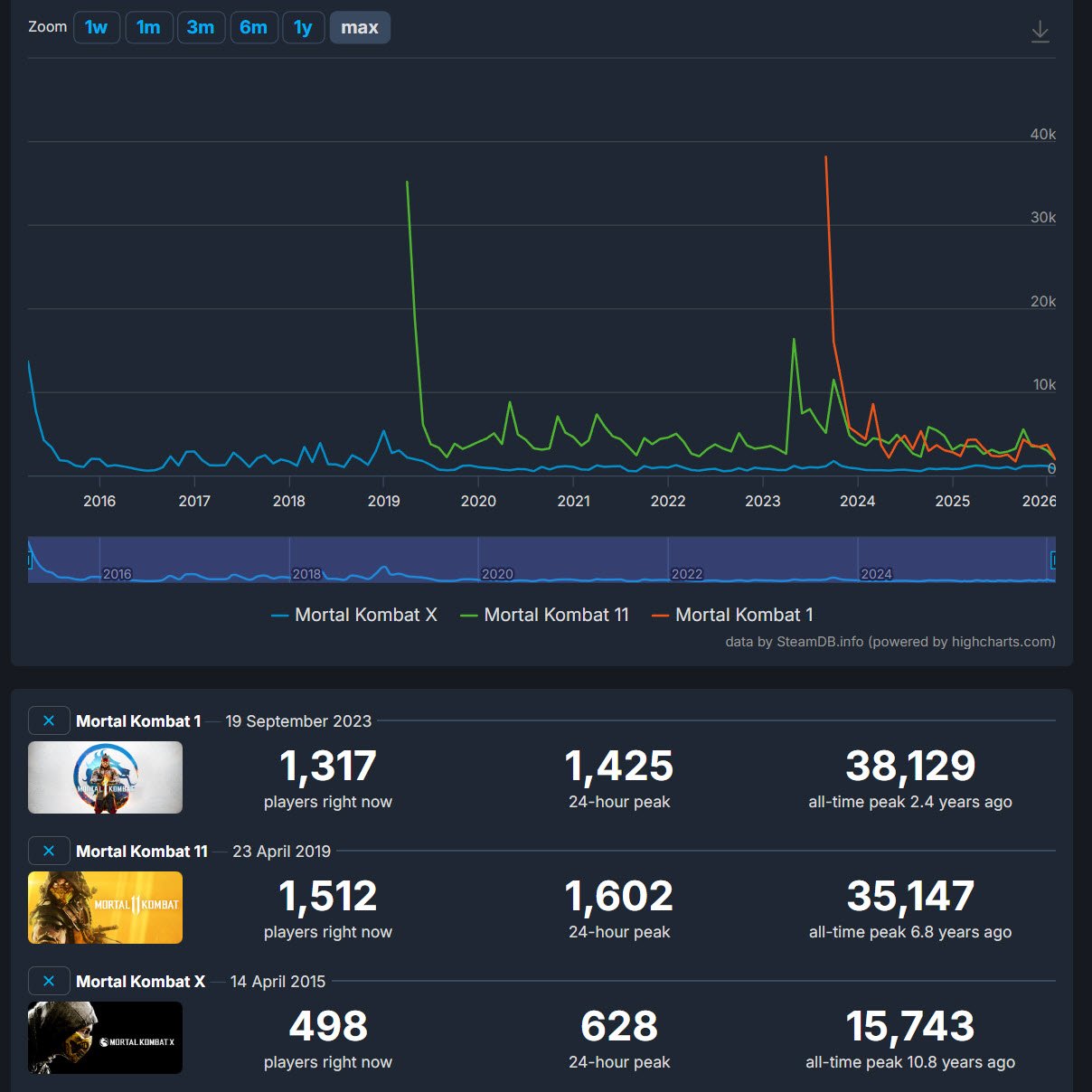
As you can see, there are currently more people playing the previous game than Mortal Kombat 1—this is not typical for fighting games, nor is it a good sign. MK11 was released in April of 2019 and received various major and minor system updates with new character DLCs until its “Ultimate Edition” was released in November 2020. Ongoing support for MK11 ended, and the game was put in its final state in July of 2021. MK1 was released in September of 2023, and a “Definitive Edition” was released in May 2025, which means that while the game will continue to be supported with patches and small updates until official support ends, no further character DLC or major system updates are going to come to it. The two games are on a similar timeline trajectory, yet more people are still interested in the older game. In fact, if you compare the attendance of competitors for the games at the annual EVO tournament, MK11 saw 1567 participants in its first year and 451 in its last year, while MK1 had only 645 participants in its first year and 377 in its last year. MK1 was also featured at EVO for fewer years than its predecessor due to the lack of interest in the game.
Why the dropoff in public perception? The game clearly still sold really well, but the community is far less interested in it than the previous entry. There’s not exactly a huge outcry or damning lamentations from the larger gaming audience as a clear indication of MK1’s steeper decline. There’s no Helldivers moment of controversy as a flashpoint indicator that something is wrong. Some streamers who played the game defended it as fun, mechanically. However, there were certain design choices and online matchmaking implementations that didn’t sit well with gamers. Nothing substantial to cause an outcry that might have made the developers rethink or reassess their decisions, but still significant enough to cause MK1’s reputation and interest to decline.
Not to belabor this point any further, but compare Mortal Kombat’s last two entries and its current trajectory to its primary fighting game rival, Street Fighter. Street Fighter 5 had a notoriously bad launch with a weak roster, bad online netcode, missing features and modes, limited system mechanics, ugly graphics, and poor communication with its community. It was a total mess, and for its entire support cycle, the developers were trying to make it up to their very upset and vocal audience. By the end of its development, the game eventually got to a decent place with improved mechanics, a significant roster of characters, and missing features and modes were finally replaced. It never quite recovered from its launch, but players were still much happier with it by its end. Street Fighter 6 has seen a much different response to its initial release and has become the fastest-selling game in the franchise as of 2025. It had a much better launch and has been well-received in the fighting game community, with a lot of positive momentum still behind it.
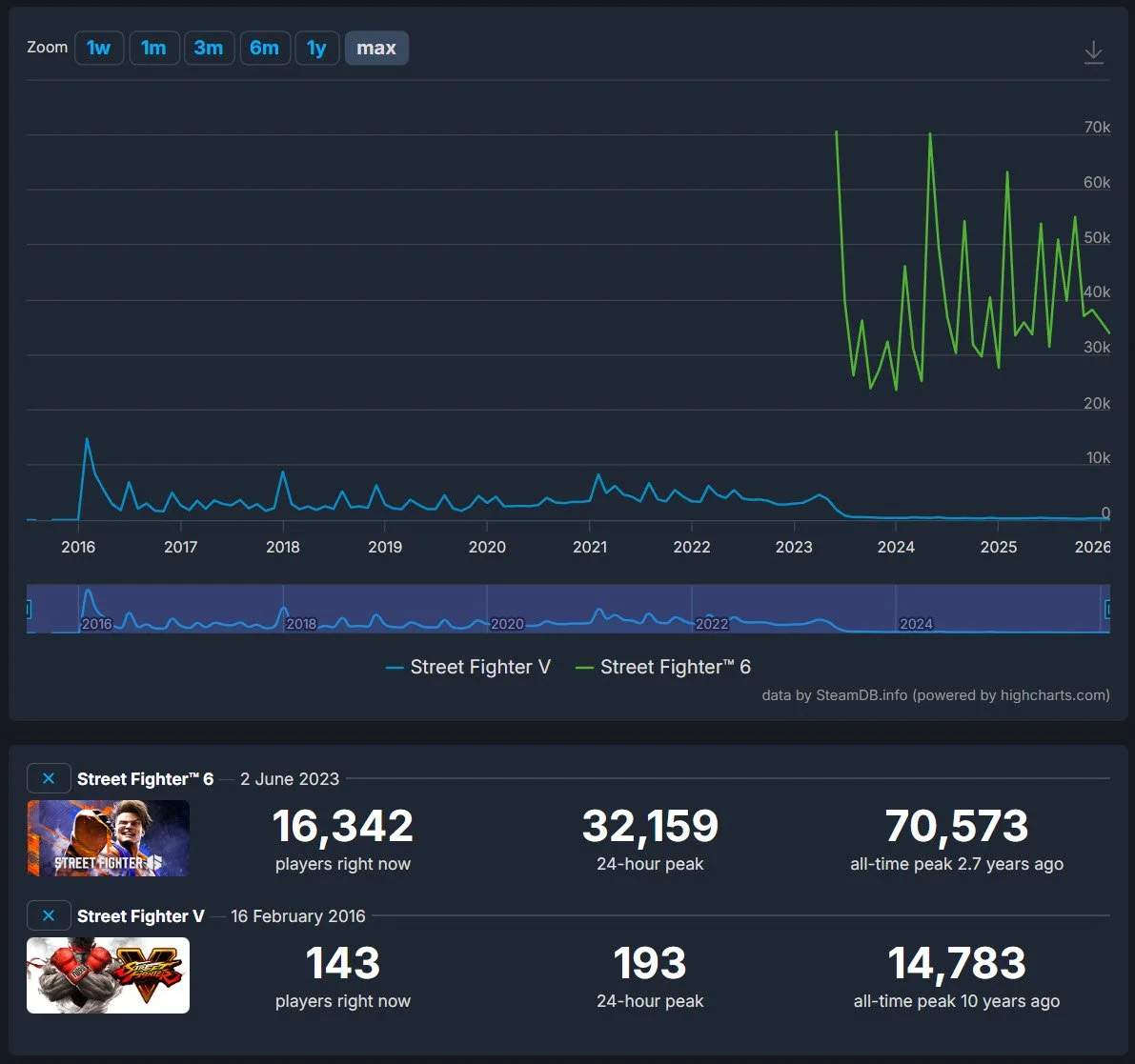
The data of the chart can’t be fully trusted due to how old Street Fighter 5 is and when the charts site started calculating the players, but you can still see a stark contrast in interest for the games based on how successful the launch of SF6 was. With new characters still coming to the game, each DLC launch has brought players back and piqued interest. For example, the release of Sagat brought the 24-hour peak back up to 50,000 concurrent players.
Why am I bringing all this up about Street Fighter? The disastrous launch of SF5 and the negativity surrounding that game were important lessons to the developers at Capcom. While the game was active, they had to do their best to right their wrongs and improve the experience of the game they were stuck with. With SF6, they drastically changed their approach to the game’s appearance, mechanics, and rollout. The DLC release cycle has been slower, but more consistently good, keeping players happy. The popular YouTube streamer, Maximilian, recently said in one of his videos about Street Fighter that “Street Fighter 6 is, legit, just the Street Fighter 5 apology tour.” Gamers were upset and vocal 10 years ago about things they didn’t like with a game. If players had just shut up and accepted all the things wrong with SF5 instead of being negative or vocal about it—like the article of Comicbook.com seems to be suggesting gamers should do—we wouldn’t have gotten the much-needed improvements to SF5 or the SF6 we have now, because the developers wouldn’t have had a reason to change.
End of Part 1
I didn’t expect to write so much about this article, but I kept thinking of counterarguments as I went along and realized that this thing was going to go on for a while. I especially want to focus on a particular game that the Comicbook.com writer mentioned in his article, which will add significantly to the word count. Come back next week for Part 2 of my response to Comicbook.com’s stupid article, in which I focus on the games that he chose as examples for his argument.