Spider-Man Remastered | Web-Slinging Busywork
As a video-game enthusiast who grew up loving Spider-Man comics and the animated TV show, I have played my fair share of Spider-Man video games over the years, dating all the way back to the original Nintendo Entertainment System (NES). The NES games were all pretty bad, as many were made by the notorious shovelware company of the era, LJN. The games on Super Nintendo and Sega Genesis were improvements, but still just basic side-scrolling beat-em-ups most of the time. It wasn’t until the PlayStation that Spider-Man games started to improve with much more variety in movement and action. For a long time, the developers behind the Tony Hawk Pro Skater games, Neversoft, were creating games for the webslinger until fellow Activision developer, Treyarch, took over, and then Beenox. I have played almost all of them from the PlayStation era on, including the bad ones, so I have quite a bit of perspective on what to expect of a game starring Marvel’s biggest superhero. This Spider-Man entry is the first that I’ve played that has been published by Sony and developed by Insomniac Games, so I was intrigued when it first came out on the PS4. Then I played it.

Image: Sony, Insomniac Games
I was having fun at first. It felt like the developers understood the assignment when it came to making an open-world game with Spider-Man. However, after a few hours of doing side-missions alongside the main story, I started to get a little bored. I put the controller down and didn’t come back to it for years. When the remastered version significantly dropped its price on Steam, I decided to give it another try with a computer more capable of handling the updated graphics and massive Manhattan map.
The Short of It
What I Played
32 hours
Remastered version 3.618.0.0 on Steam
100% completion of the main story
Completion of The Heist DLC
Pros
Web-slinging and movement are fun and intuitive
Some combat mechanics are interesting
A few fun boss fights
A decent puzzle mini-game
Plenty of ways to fight crime and save people
Many costumes to gain and swap
Animations of Spider-Man and all his special moves look good
Voice acting is well done
The massive map looks impressive
Cons
Many of the side missions are uninteresting busywork, which are required for costumes and abilities
Plenty of repeated voice lines
Stealth sequences, while not terrible, are not usually interesting, except for a couple of exceptions
Far too many people seem to know who Spider-Man is by the end of the game
Certain characters act out of character
Some special abilities are too strong
Certain enemies are not fun to fight
One particularly frustrating sequence in the Heist DLC
The Rest of It
Story
Peter Parker has been Spider-Man for a few years now. He has garnered a reputation in New York among the public as the friendly neighborhood webhead, especially with his help in the recent successful arrest of the Kingpin. Despite the efforts of J. Jonah Jameson on his fringe podcast, attempts at smearing the hero are often disregarded, as many people seem to be happy that Spider-Man is around to help. Of course, being Spider-Man affects Peter’s personal life (as it always does), and he often finds himself late to appointments. He’s late to his work, where he assists Dr. Otto Octavious on his new prosthetic experiments. He’s late to his volunteering appointments at the homeless shelter where Aunt May works. He’s late to awkward meetings with his ex, Mary Jane, who has become a journalist at the Daily Bugle since their breakup.
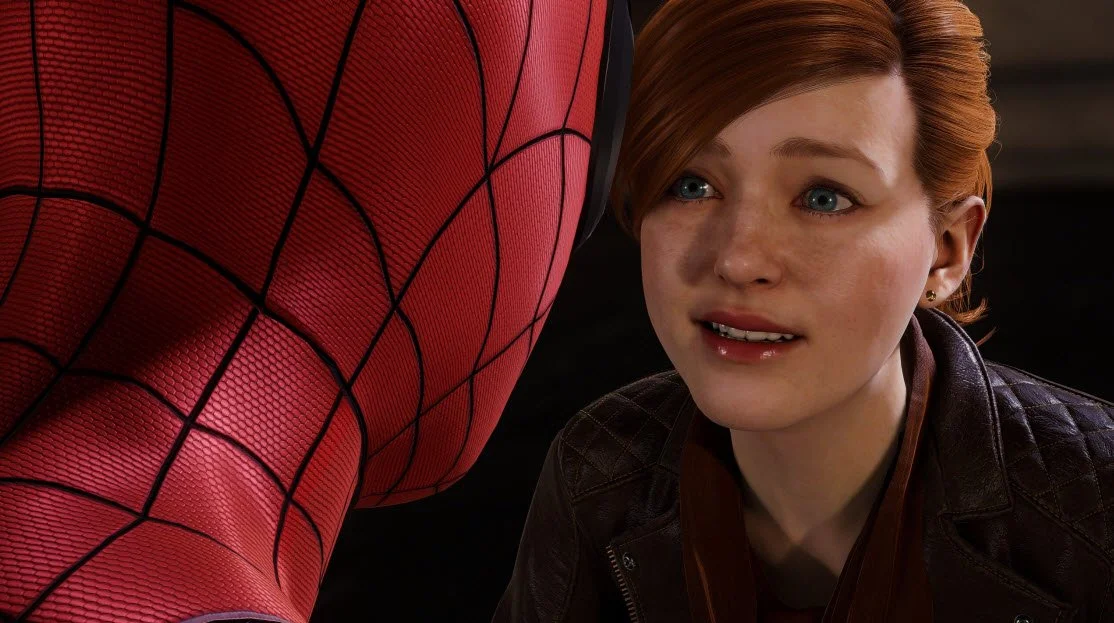
Image: Sony, Insomniac Games
One day, the mayor of New York, Norman Osborn, comes into Dr. Octavious’ workshop and, essentially, shuts him down by rescinding permits and confiscating equipment. He even takes their volunteer test subject by offering him an opportunity to get better products at Osborn’s company, Oscorp. This enrages and depresses Octavious, who sends Peter away, defeated. Shortly thereafter, an associate of Aunt May, Mr. Lee, leaves the homeless shelter due to a mysterious personal emergency. While Peter’s personal life is in disarray, having lost his job and his apartment, a new gang adorned with demon masks starts committing crimes in New York in the wake of Kingpin’s absence, seeking to fill the power vacuum. After a few significant attacks on public figures take place, Spider-Man must face off against some of his toughest foes while still trying to juggle his personal life.
In terms of a Spider-Man story, this works. Unlike the Fantastic Four, the Avengers, or the X-Men, Spider-Man has always been more of a singular, personal superhero. Even though he’s the most popular Marvel hero, he’s not supposed to be the one dealing with the big world-ending events. That isn’t to say that he’s never involved, but the problems and the villains he faces are often less significant in the grand scheme of Marvel storylines. That’s why the overall story of this game works for the character of Spider-Man better than some of the webcrawler’s games in the past.
That being said, there aren’t many surprises to be had in this game. If you’re familiar with Spider-Man or his villains at all, you mostly know where the story is going and who the ultimate villain is. The more surprising instances are mostly due to characters being different from how they’re normally portrayed. A more sympathetic perspective is given to Norman Osborn, even if he’s still a manipulative politician. Mary Jane playing the role of an April O’Neal journalist who constantly gets in trouble for Spider-Man to save is not really my preference, but it at least gives her a reason to be more involved in what Peter is doing as the masked hero, so it gives a different dynamic to their relationship than what it’s been in the past. Peter’s friendship with Octavious is given more weight than it usually gets, and there are some satisfying pieces of complexity in the latter portion of the game after several revelations occur. There is a decision that Peter makes at the end of the game that I do not agree with, which I won’t spoil, but it simply is something Spider-Man/Peter Parker would not do. All I’ll say is that, even though he’s a superhero who is constantly putting his life on the line for others, when it comes to the people most important to him, he would not choose “the greater good” over them.
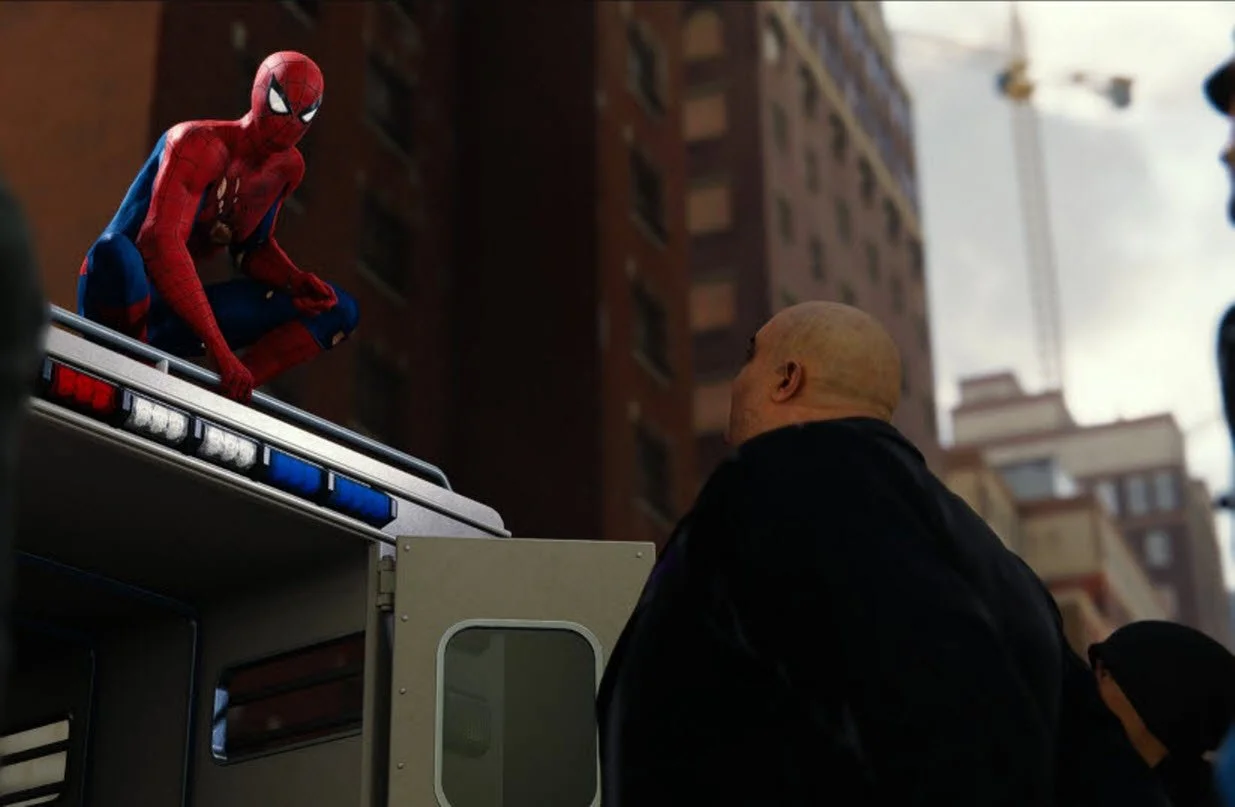
Image: Sony, Insomniac Games
The main issue with the story is that it’s still a relatively thin plotline. There are some key events that take place, which provide the throughline for the story to push things along and introduce new enemies or mission types, but it never feels like a truly cohesive story. It’s more like different events that are all loosely connected through specific characters. Such is the challenge of an open-world game, but if you compare it to something like Red Dead Redemption, there’s a core character motivation from start to finish in that game’s story. Since this is a Spider-Man game, the focus is more on Peter’s ongoing relationships with other characters as he finds time to fight crime and uncover what is connecting the attacks with the demons to the other events in the city—a fair amount of the dialogue and plot is dedicated to Peter Parker’s connections to the other characters. There are some unrelated side missions and DLC that add some more interactions with iconic Spider-Man characters, but after finishing the Heist DLC, I was pretty burned out on the game and didn’t feel the need to go any further.
Gameplay
Spider-Man’s gameplay can be broken up into several different aspects.
Traversal
Easily the best part of the gameplay, the design of Spider-Man’s movement and traversal mechanics make this game fun. Webslinging has never been better in any of the Spider-Man games that I’ve played. The developers managed to make Spider-Man move quickly and deftly through the air and along the sides of buildings. A common issue in previous Spider-Man games was the various obstacles that would stop your momentum dead in an instant, like those pesky fire escapes on the sides of buildings, but the developers came up with nifty methods in which you are able to maintain your momentum and swing or zip around from building to building if you run into those types of obstacles. There is also fast travel to allow you to quickly get from one section of Manhattan to another, but I rarely used it because it was more fun and still rather fast to just websling. The only instance I had any issues with the traversal was on a particular mission in the Heist DLC, in which I had to quickly keep up with a subway train and continuously got stuck on pieces of geometry in my quick attempts to zip forward and avoid obstacles with a short time limit.
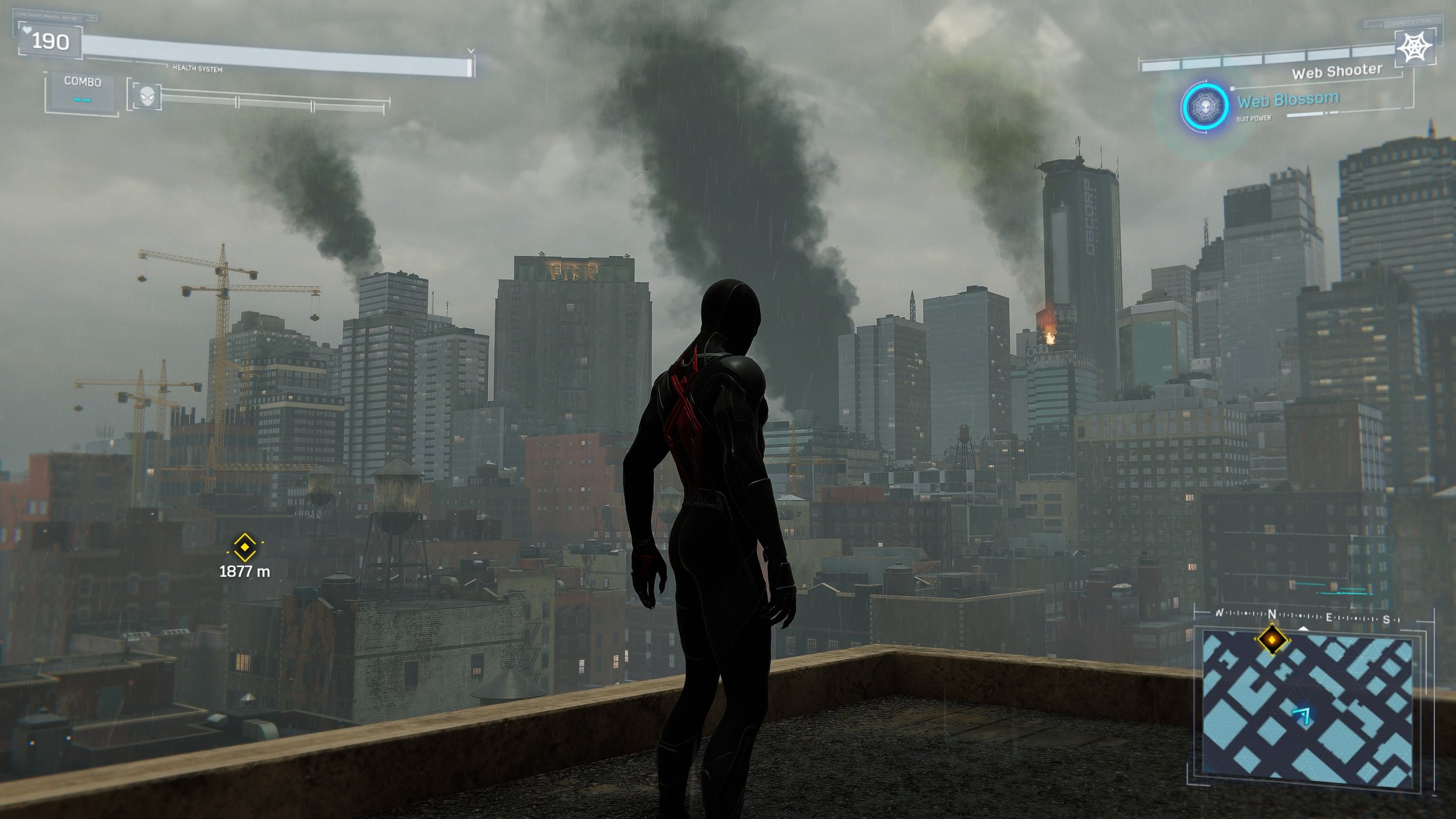
Image: Sony, Insomniac Games
Combat
Another positive aspect of this game is the combat, mostly. There is a decent amount of moves you can acquire over the course of the game that adds a level of complexity to the experience. Some are simple add-ons to combos, while others allow you to grab and throw objects or enemies. Most of the time, your goal is to get as many of the goons webbed and stuck on the ground or walls as quickly as possible so you can focus on dodging attacks and knocking guys into the air.
You can also get more gadgets to help you in various scenarios, most of which involve webbing up enemies quickly, like the web bombs or web traps. There are also some more unique gadgets you can use during a fight, like spider-bots that can distract enemies, levitation fields, and wave blasters that send guys flying. There’s a limitation on each gadget in terms of cooldown and number of uses during a fight, but you can acquire abilities and buffs to Spider-Man that will refill the gadgets as well.
In addition to the gadgets and combat upgrades, you get access to specific special moves that are associated with a suit in your collection. As you progress through the game and gather tokens, you can use those to unlock different outfits, many of which have a special move of varying degrees of usefulness during a fight. Some are simple battle-focused skills that buff Spider-Man’s attacks for a short period of time. Some act like scanning modules. However, I rarely used any of them other than one of the first suit skills you get, called the Web Blossom. It’s surprising that it is a skill you get so early in the game because of how effective it is and how quickly the cooldown ends. It’s essentially a win-the-fight-automatically move. Spider-Man leaps into the air, shooting webbing in all directions for a few seconds, most of which ends up attaching enemies to walls or the ground and putting them out of commission. If you happen to encounter a mob in an alley, jump into the middle of the crowd with this move, and you’ll immediately win; I can attest to it.
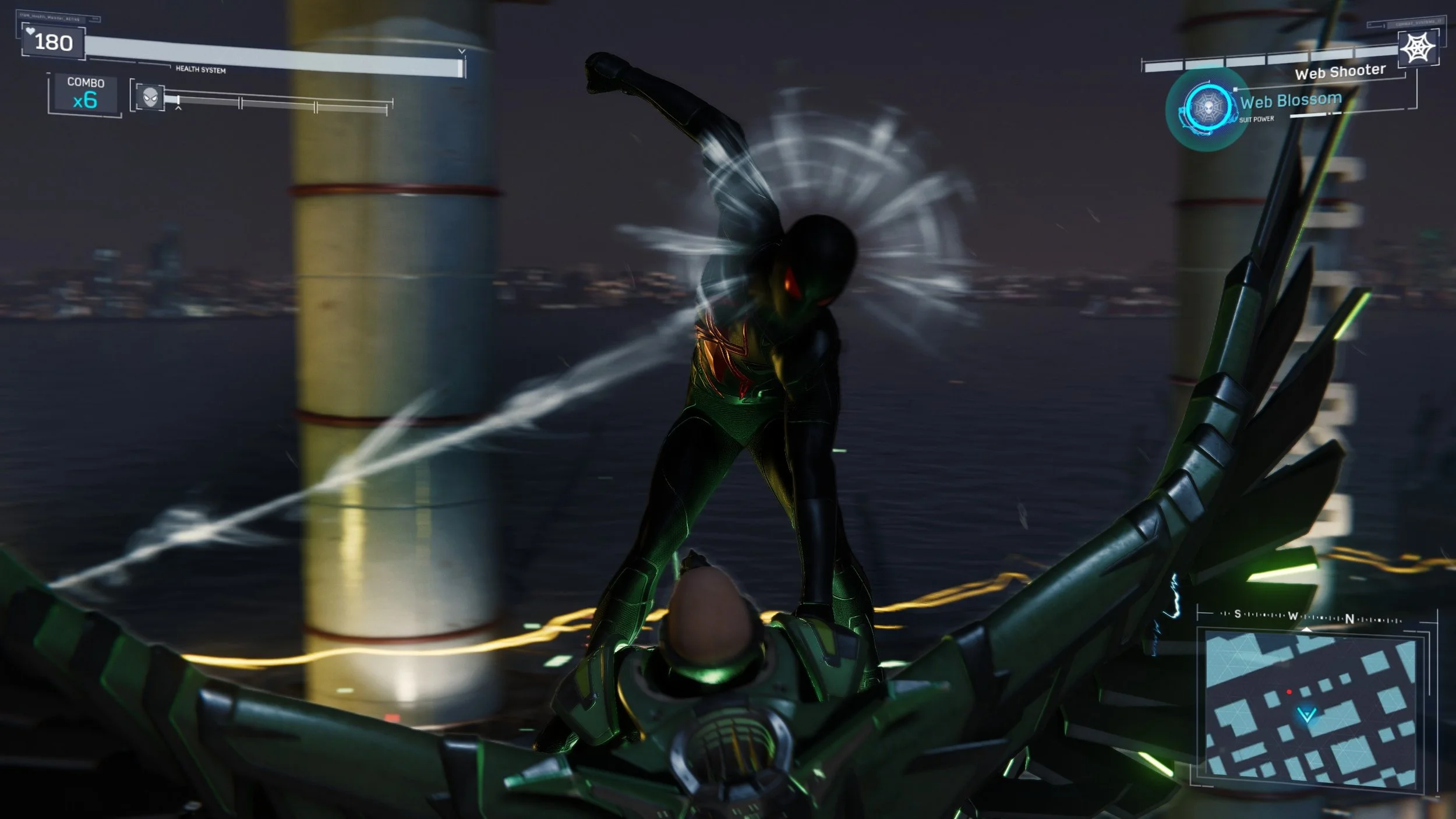
Image: Sony, Insomniac Games
There were a few times I died during combat in Spider-Man, but most of the time, it was pretty easy on normal difficulty, especially with the Web Blossom move. Since you get access to a lot of skills, gadgets, and buffs by the end, the types of combat encounters get tougher with new enemies and different weaponry used against you that can kill you rather quickly if you are not careful. I never got completely bored by the combat, but there is certainly enough to go around that it was starting to get a little dull by the end. Thankfully, there were some interesting boss fights with some of Spider-Man’s most notorious villains to spice things up.
Stealth
At last, we come to the elephant (or rhino) in the room for many people. Stealth is a genre of video games that I quite enjoy and have ever since it first arrived with the likes of Tenchu, Thief, Deus Ex, Siphon Filter, etc. It’s a genre that, done right, can be immensely satisfying. The other side of that coin, however, is bad stealth. Poorly implemented stealth mechanics can lead to extreme frustration. There was a period of time in which undercooked stealth mechanics would be forced into countless games that were not primarily about stealth. Almost every time I have played or watched someone else play a game with that situation, it was easily the worst portion of the experience. Since the Arkham Batman games, though, I’d say that developers are generally getting better at implementing it as a side mechanic.
Spider-Man takes some notes from the Batman games, but is nowhere near as good or complex. When approaching enemy bases, you can opt to take guys out silently before they see you. You can yank them up and pull them into a web, you can zip to them and knock them out, or you can use certain web gadgets to attach them to their surroundings. Scanning the area tells you whether or not it’s safe to do a stealth attack. Most of the time, it was easy to take enemies out without being noticed because they would go looking for those who have gone missing and separated from each other. If you’re spotted, it usually just transitions to a combat scenario, unless the mission circumstances require that you not be seen. It’s fun to do quickly as a challenge to see how many and how fast you can get rid of them, but it’s not complicated enough to be satisfying to do all the time.
But that’s not the type of stealth players are worried about. Players don’t mind stealth attacks that Spider-Man can do because if he’s caught (most of the time), you can just start fighting guys instead. The stealth that many players don’t like is when you have to avoid being seen by clinging to corners and avoiding the vision of patrolling guards, unable to eliminate any threats, and being spotted means immediate failure and starting over. For many players, this was a sticking point with Spider-Man because they are indeed in the game.
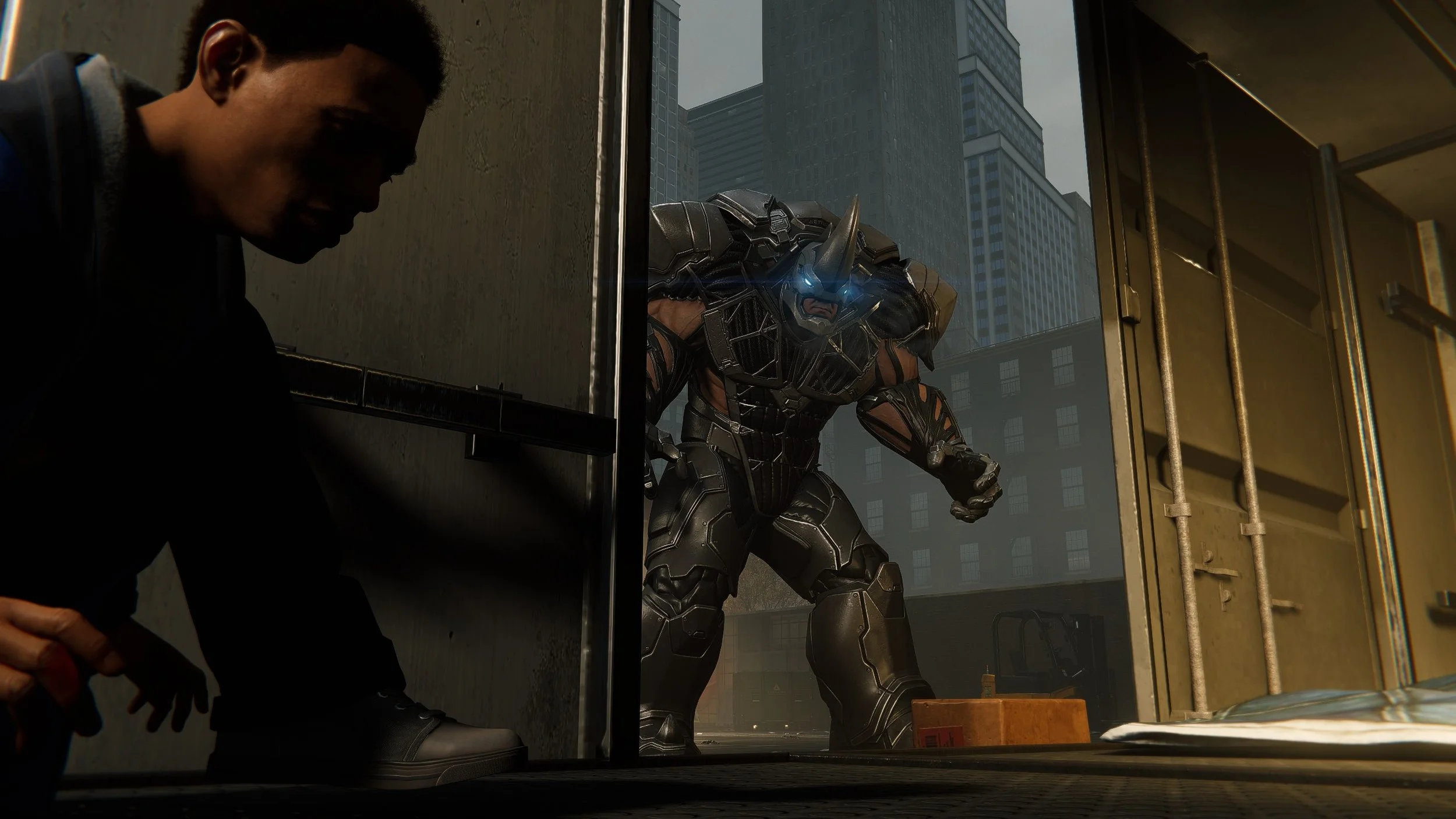
Image: Sony, Insomniac Games
However, I did not mind them that much. Yes, they did stop the momentum of the game when they occurred. Yes, there were times when there was an unfair scenario in which I got caught, despite understanding what I needed to do. But the segments were usually relatively short, and you were given some distraction tools by the end that allowed you to get around guards more easily without getting caught. One stealth segment I actually enjoyed was when Mary Jane was at Grand Central Station and Spider-Man snuck in. Playing as Mary Jane, you sneak around and then target guards for Spider-Man to zip down and snatch without being seen. Again, not very complex in terms of mechanics, but also still a rather brief stealth section that didn’t overstay its welcome. I might be biased in my opinion since I like stealth games, but these segments could have been far worse than they were. There could have been many more of them, too, and I think this was just the right amount.
Puzzles
While there aren’t too many different varieties of puzzles in Spider-Man, you will still do plenty of them. The two main puzzles that repeated were the electric current puzzles that were very similar to the hacking puzzles in Bioshock, in which you arrange different tiles on a grid to get the right amount of energy to flow from the start point to the exit point. The other common puzzle was one in which you would select certain image tiles that would layer on top of each other to form the desired pattern. Neither puzzle was very difficult, and the pattern puzzles could have been brute-forced with the process of elimination pretty quickly. The electric current puzzles were more engaging and appeared a little more often, with a significant chunk of them being in Dr. Octavious’ lab.
Busywork
With all those mechanics laid out, what does it all amount to? It’s an open-world game, so side objectives are expected to be part of the experience to keep you engaged when not approaching the main story. Insomniac filled the map of Manhattan with various sorts of activities for you to do that included these different mechanics. This included active crimes taking place, lab experiments, timed trials, side quests, landmarks, backpack collectables, and enemy bases.
As you swing through the city, crime events will often begin. You can choose to ignore them, but every district has a certain number you’re expected to complete before the zone is marked 100%. I liked the crime missions as they were a simple diversion from swinging around, which also added to the experience of feeling like the friendly neighborhood Spider-Man doing what he’s supposed to do. They varied in complexity by the end, with some bomb threats and carjackings to make them more than just the usual combat encounter. Landmarks were just places you take pictures of with your in-game camera, and they were as engaging as the backpack collectables. Some of the timed trials were fun, though most of them were pretty challenging to get the top grade. Enemy bases were just lengthy combat encounters in which you had to eliminate waves of enemies. The lab experiments had a bit of a story element each of them. They were the activities that varied the most in terms of what was expected of you in order to complete them. Some were interesting, as they managed to do the most with all of your different abilities and mechanics, but a majority of them were just timed missions that required you to swing around to something and potentially shoot something with your webs.
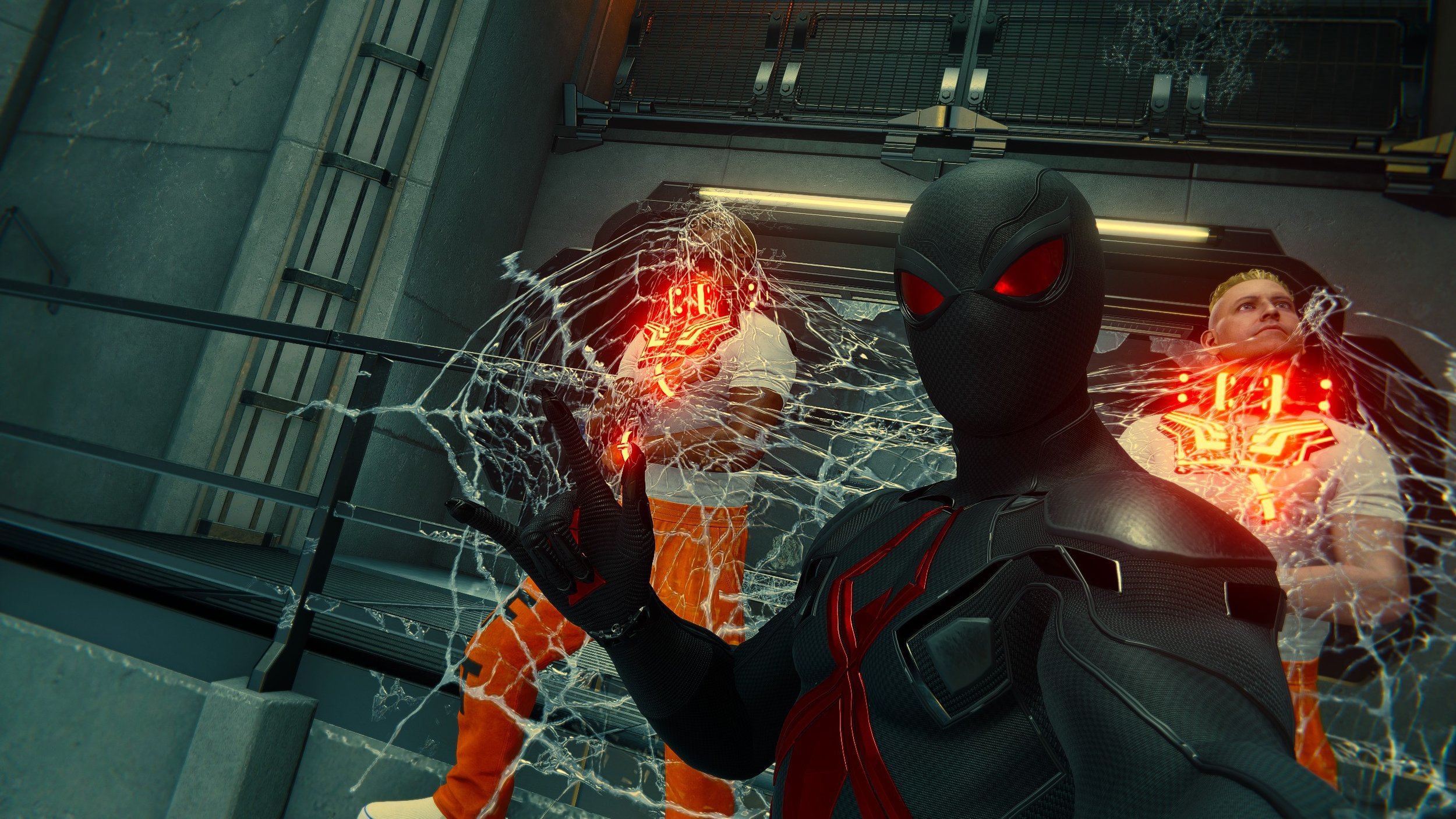
Image: Sony, Insomniac Games
You can, of course, choose not to do everything on the map if you don’t have the obsessive-compulsive desire to get 100% completion of every task. However, you do get rewards for completing the side tasks. In addition to experience and new abilities, you get tokens that are necessary for new Spider-Man costumes and gadget upgrades. As I mentioned, most of these unlockable costumes come with a special ability, which means you’ll want to get them all if you want to try each of them out. Again, you get the best skill (Web Blossom) practically by default, so you don’t need to do it.
As this section title and the title of the review suggest, there’s a lot in Spider-Man to do, but not enough complexity or variety to prevent it from feeling tedious. It’s the main challenge that the open-world Spider-Man games have faced over the years, and none have fully managed to eliminate the repetitiveness. This game is, arguably, the most successful at giving you enough to do over the course of the story that feels like you’re not just doing the same thing over and over again, though I would argue that some previous games did certain things better. For instance, I think the combat, while good and with some variety, was better in Spider-Man: Web of Shadows. The sense of doing a lot of the same tasks over and over was what made me turn away from this game originally. I was able to power through it this time, but I was still starting to get bored by it halfway through. Playing in doses definitely helped.
Presentation
Rendering a massive map with countless buildings and skyscrapers is already an impressive feat, let alone being able to render numerous cars and New York citizens walking around. To do all of that while being able to maintain a decent frame rate as Spider-Man swings through the sky at high speeds is what makes the presentation of this game so impressive. I wouldn’t say that the frame rate was always consistent, but it never dropped to slow speeds that negatively hindered the performance. Previous Spider-Man games often struggled in this regard and had to keep much of Manhattan in a fog so it didn’t have to render too many buildings in the distance. Standing atop the Avengers tower in this game, you can pretty much see all of the city from east to west.
The details also look pretty good. The faces of the main and side characters look good, even if not as great as something like Cyberpunk 2077. The way Spider-Man animates as he swings through the city or fights thugs is great. Most of the textures looked good as well, particularly on Spider-Man’s costumes. Still, it’s an open-world game, so I saw my share of glitches.

Image: Sony, Insomniac Games
The music is quite good, as you’ll often hear the orchestral tunes come in as you swing through New York. The main theme sounds similar to his MCU theme, but it has its own personality as it swells and boosts during times of drama or as you go faster through the air. Voice acting of the cast is all solid, with great work by Yuri Lowenthal, who voiced Peter Parker. There were plenty of lines I heard repeated throughout my experience, but there was enough variety to keep it from sounding like the various thugs in the Batman games, where I heard lines like “Arkham City, go to hell” dozens upon dozens of times.
TL;DR
This game gets a lot of positive reviews, and I can see why. Swinging through Manhattan has never been better. Combat has a decent amount of variety and moves to keep things engaging for a while. The way this game looks and sounds is pretty impressive. However, I still think a lot of the gameplay amounts to busy work that can start to get dull by the end, and the story is not as interesting as other Spider-Man games have been. Nonetheless, I enjoyed my time with it overall. I just had to take the game in doses so I didn’t burn myself out on busywork.